For those of you who are remotely interested in the Big Dig and have been following its progress (not the horrendously expensive, obstacle ridden, near fiasco of a tunnel construction project in Boston, that became most expensive highway project in American history to date, but the less expensive, though no less budget crippling, obstacle ridden, infuriatingly complex garage/shop building project that has consumed Ked's and my money, time and limited patience for approximately the last five months), I have momentous news to report--THE GIANT DIRT PILE IS OFFICIALLY GONE!! Yes, our mountain of earth and rocks, produced by the excavation of the shop foundation, finally bit the dust, as it were, and none too soon, for, this being Oregon, if we hadn't disposed of it in time it was going to have to bite the mud. This is a big relief. There are now only about six more relatively major projects we have to do before the garage site can be inspected again by the erosion control inspector, and then by the building inspector for final approval. I wish I was exaggerating about what's left to do, but I'm not. We do, after all, live in the heart of The Alliance.
Now that you have the project update, perhaps we should move on to more interesting topics. I, for one, am ready for a break from even the thought of digging, and am instead spending my morning digging through various websites for information and punditry. I've read a couple things of note that I want to send your way. Although they are quite dissimilar in topic, I thought I'd toss them to you in one shot. I haven't taken the time to do any analysis of them myself, or to fully develop my own thoughts on what they have to say. I just thought they both were worthy of a recommendation for you to give them a look.
The first is a piece at Real Clear Politics, by Michael Barone, (via Instapundit) on the mental state of the American electorate with the November elections looming, why people are leaning the way they seem to be, and whether that's a good thing. The other is an article in The Weekly Standard, by Michael Yon, about journalists embedding with the U.S. military in Iraq and Afghanistan, why doing so has gotten harder in the last year, and why that needs to change. Neither of these pieces are fluff, or even particularly cheerful, and the one by Yon is quite long, but I really respect both these guys' opinions and think reading the articles was time well spent. I'd also be interested in any reactions you might have, especially to the Yon piece, so come back and share your thoughts if you feel like it.
Monday, October 23, 2006
Digging

Saturday, October 21, 2006
The Nobel Peace Prize
Here's an excellent piece, by Alvaro Vargas Llosa at TCS Daily, on successful entrepreneurship in impoverished countries, and people getting out of poverty, and the Nobel Peace Prize actually going somewhere that doesn't reward duplicity, or incompetence. Cool.
Update: I just read the article to my husband, and he agrees with me that it's well worth your time. Really, go read this one. It's a wonderful look at how successfully the poor can help themselves if they are offered the opportunity of a modest investment, without undue hindrances to enterprise. This year's Nobel winner is, if you can believe it, a bank in Bangladesh, which is a strictly for-profit venture, and yet is transforming the lives of the poor. Llosa explains how Grameen bank contributes so much to the well-being of the community:
The bank lends tiny amounts of money to village-dwellers so they can start small businesses. The scale can be so modest as to involve the purchase of a cow in order to sell milk. Since no collateral or credit history is required, the system works on the basis of trust and peer pressure: Lenders are placed in groups of five, with part of the group guaranteeing the loans of the rest. If a loan is not repaid, the community shuns the borrower.He goes on to explain how, after half a century of continually increasing foreign aid--rich country to poor country charity--the poor are actually worse off in the nations that have received the bulk of the money. Surprised? He also looks at the effects of entrepreneurial opportunity in poor communities, and concludes that this opportunity, not handouts which create dependency, is the key to improving conditions for the poor:
What the poor really want is an environment in which undertaking a profitable venture is not a nightmarish bureaucratic and legal process. The world is full of examples of poor and uneducated communities that have been able to create wealth thanks to entrepreneurship, rather than governmental assistance. I have been looking at cases of entrepreneurial success around the world for the past year and the conclusion is overwhelming: The best way to fight poverty is to eliminate barriers that currently hold back private enterprise among the poor.Have a look. You might be encouraged, or surprised, or both.
Thursday, October 19, 2006
Are We Supposed To Be The World Police, Or Not?
Victor Davis Hanson has a good explanation of why the U.S. will probably stay away from helping the victims of genocide in the Darfur region of Sudan, as tragic as that situation is. I'm sure most of us know what's happening there. The Arab Muslims are killing the black Muslims and non-Muslims, and Hanson says that, given the U.N.'s inaction to stop the slaughter, humanitarians are calling for the U.S. to interject itself where the U.N. is so impotent to act. He also says these humanitarians will likely not get the action they want from the U.S., partly because of their own inconsistency.
Okay, here's a situation where the world's watchdogs want us to make the other kids play nice. Apparently, sometimes unilateral action in the face of U.N. ineffectiveness is good. Noted. (It's interesting to note also that along with Sudan, North Korea and Iran are both situations that we're supposed to negotiate--read "deal with"--unilaterally, despite the fact that we're supposed to get the world's approval for everything else.) In any case, Hanson makes the argument that the very people who are calling for our intervention in Darfur are the same ones saying we should not have intervened in Iraq. (Warning: sarcasm to follow.) Apparently we had something to gain from Iraq, which is a no-no. You know, the whole "oil for blood" thing that has us awash in all that petroleum we scored out of the deal. (Sarcastic moment over.) Since we could have nothing to gain from getting involved in Sudan, some are calling for us to go be world police again.
Hanson, though, also goes on to say that if President Bush did make the decision to commit troops, or bombs, the same people now criticising him for inaction would turn on him as soon as boots were on the ground and the inevitable happened. What's the inevitable? I'll paraphrase. 1) Terrorists would flock to the region to fight the Great Satan, just as they have done in Iraq. We are, as we all know, the genesis for all terrorist activity. Therefore, terrorism in the region would become "our fault." 2) American soldiers would die. This is not inevitable, but it is highly likely, and once that happens the results would again fall on the administration's head for sending our troops into harm's way. 3) Innocent civilians would die, either because they are in the wrong place when a bomb goes where it's supposed to, or because a bomb goes where it's not supposes to, or because they are mistaken for bad guys, or any number of other realistic scenarios. As Hanson put it:
Again, far more importantly, we all suspect of the Sudan that should Americans get ambushed, should a plane go down and its pilot be beheaded on Sudanese television, should a bomb go wide and kill some civilians on CNN, both the world at large, and the American Left in particular, would be the first to turn on the United States for not being perfect when we were still doing a great deal of good.The long and short of it is that we are damned if we do and damned if we don't, and, as Hanson makes clear, we have an awful lot of other pressing issues on our plates at the moment with Afghanistan, Iraq, Iran and North Korea. Hanson goes on:
We are developing in America a new reactionary aversion to force, that may soon surprise the UN, the Europeans, and our own left anti-war crowd that clamors for humanism in our foreign policy, even to the point of using arms to stop evil. But given the invective against our efforts first in Afghanistan, and then—and especially—in Iraq, such critics have almost destroyed entirely neo-conservative muscular support for democratic reformers.Personally, I'd just as soon see the U.S. do something anyway. As Hanson says, "...a single aircraft carrier could enforce a no-fly zone over the country, while a brigade of American troops could shatter the poorly-led and poorly-trained bullies who are killing the innocent. " We all know the U.N. is useless, and it's not like world opinion isn't already set, regarding the Bush administration. Truth is, we'd be protecting Muslims, too, which actually could garner some support from the parts of the Muslim world that aren't Arab. Oh wait, we would also be protecting them against Muslims, so I suppose the two would cancel each other out. In any case, my point is that, since the people who hate us are going to hate us anyway, it would be better to intervene. Somebody needs to, and no one else is stepping up to the plate. Hanson's point, though, is that, given how vociferous the same people who are now calling for that intervention have been about condemning the administration for other interventions, the chances that the U.S. will get involved are slim. That just adds one more layer of tragedy to an already tragic situation.
Hat tip: Instapundit
Engage The Cloaking Device, Sir? No, Please Don't!
I got an email from New Scientist this morning, announcing that a "working invisibility cloak" had been "created at last." "At last?" I thought to myself. "What, like we've all been sitting around wondering what's taking so long?" Never mind that this is one of those science fiction type of concepts that most of us think must be heavy on the fiction, despite all the technological breakthroughs of recent years. I just don't really think I'm comfortable with the idea of invisibility being an option. I have not been pining for the day when enemy planes can fly over New York undetected. I also am not anxious for terrorist bombers to be able to walk with impunity through a crowded mall, looking for a properly substantial number of people to target. I have not even been impatiently checking the latest scientific journals for signs of progress in the fine art of "cloaking," frustrated that I can't yet slip into a room and hear what's being said about me when no one thinks I'm around. I don't want to know. Some genies are better left in the bottle.
Fortunately, upon reading the fine print in the article Justin Mullins wrote for New Scientist, I discovered that the technology is not quite as far along as the headline made it sound. Air Force commanders will not be telling their helmsmen to "raise shields and engage the cloaking device" anytime soon. (Although the shields are coming along, from what I've read, and are a much better idea than the cloak, if you ask me.) The progress that has been made, at Duke University, is in the "microwave region of the electromagnetic spectrum," which means that scientists can now bend light around an object at a very specific frequency, and make it "disappear"--albeit a frequency which people can't see, and only in two dimensions.
It's still a remarkable scientific breakthrough, and the first step in what David Smith, a member of the Duke team, said he hopes will lead to "a 3D structure that could hide an object completely from view." When he says "structure," he means it. The success they've had to this point rests in a set of rings that encircle an object completely--the object in question for the tests at Duke being a copper ring, that mostly disappeared. There was still some distortion to indicate the ring was there, but mostly invisible is still mostly invisible. I'm betting if you didn't know to look for it, you probably would miss it, if you could see it in the first place, that is, which since we're talking microwaves, you can't, but...(moving on.)
Multiple steps led up to this amazing, if somewhat undesirable, accomplishment. The set-up involved creating new materials:
In recent years, materials scientists have made rapid progress in making so-called "metamaterials", which can have exotic electromagnetic properties unseen in nature. These are made up of repeating structures of simple electronic components such as capacitors and inductors.
In 2001, Smith built a metamaterial with a negative refractive index, which bends microwaves in a way impossible for ordinary lenses. Now he has gone one step further.
The one step further is the aforementioned rings, which "distort an electromagnetic field as it passes through." According to Smith, they "steer microwaves around the central region of the device," the region where they stashed the copper ring. Needless to say, the way they can tell it worked must involve fancy machines that can detect electromagnetic waves in this range, since we're not talking about something that's visible to the human eye. Making these materials in such a way that the results could be seen (or not seen, as it happens), creates some challenges. Mullins clarifies, "The problem with visible light is that it has a much smaller wavelength, meaning an optical metamaterial would have to be built on the nanoscale, which is beyond the limits of current nanotechnology." (Probably not for long. We know how nanotech is advancing by leaps and bounds.) There also would still be limitations as to frequency--Smith says even nanomaterials would still only work on one frequency. They'll have to work on that if they want to make Federation vessels disappear, or make spies' jobs really, really easy.
I have no doubt the problems can be overcome, maybe not in the immediate future, but probably sooner than I will be ready for such technology to make its way into ubiquity. Am I the only one who finds such an "advance" to have dubious merit? Maybe I'm just in a tech funk. Saturday I wrote with disapproval about the latest form of scientifically invented self-flagellation. (Some of you will remember the post about the mirror/camera combo. It's a different kind of "guilt mirror.") I don't think that's it, though. I really just think it's that some things bring up that old truism that just because we can build something doesn't mean we should. All of the applications I can think of for this new scientific direction are either nefarious, or pointless. Can anybody help me out here? Anyone else have an idea of how to use this in a good and fruitful way, especially one that can't be abused by the bad guys?
Wednesday, October 18, 2006
The Hood River Trek Pictorial
Well, yesterday I told you all a bit about our day trip to Hood River, and I thought maybe you'd like to see some of the photos from our adventure. I know this isn't current events, or science, or politics, or any of the things I usually bring you. It's a bit of self-indulgence, really. I enjoyed the day, and like the pics, and am looking to drag you all into the memory--but who couldn't use a little colorful diversion in a sometimes dreary world? So here we go.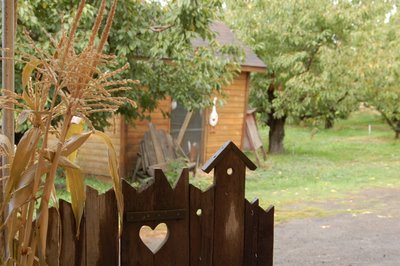
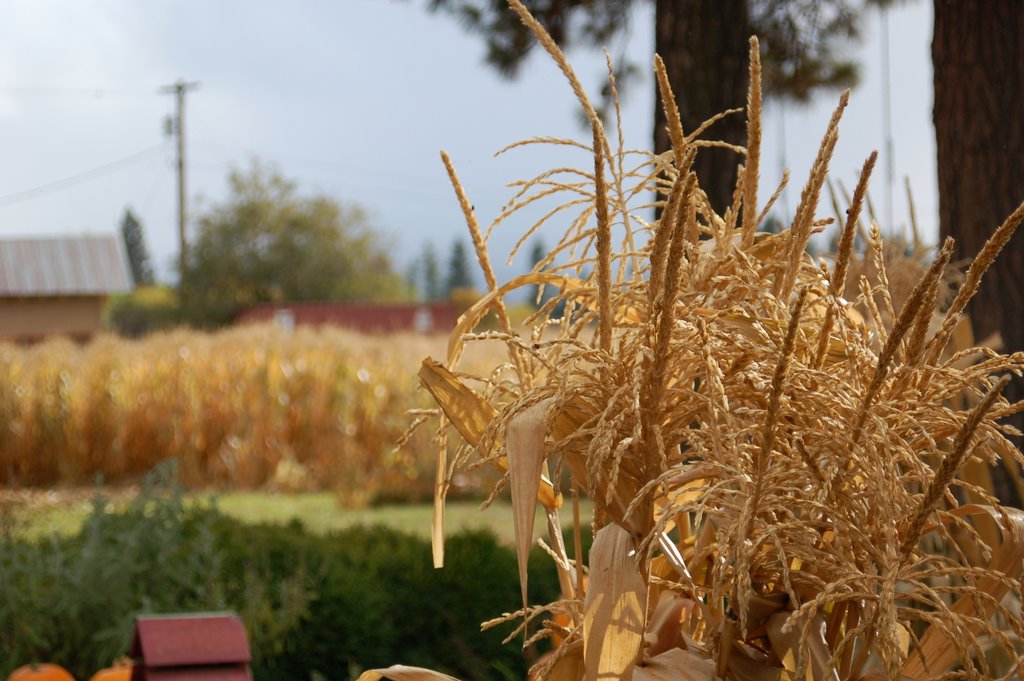 Draper Orchard, where we go every year to stock up on our winter supply of pears and apples, is just all kinds of charming. There are beautiful views in every direction, and little groupings of pumpkins and sheaves of wheat, and other decorative touches make the family farm a lovely escape for us city folk.
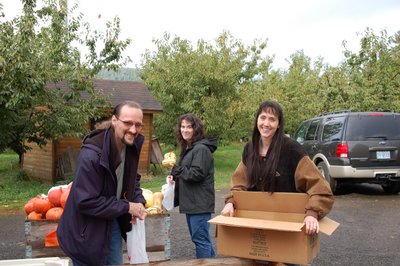 My husband and I are are stocking up on fruit here, while our more artistic friend looks through the decorative gourds and pumpkins for just the right centerpiece.
 We speculated that some of these more interesting-looking offerings of nature were actually alien pods, and that if we took any home, we could look forward to an alien infestation when they hatched.
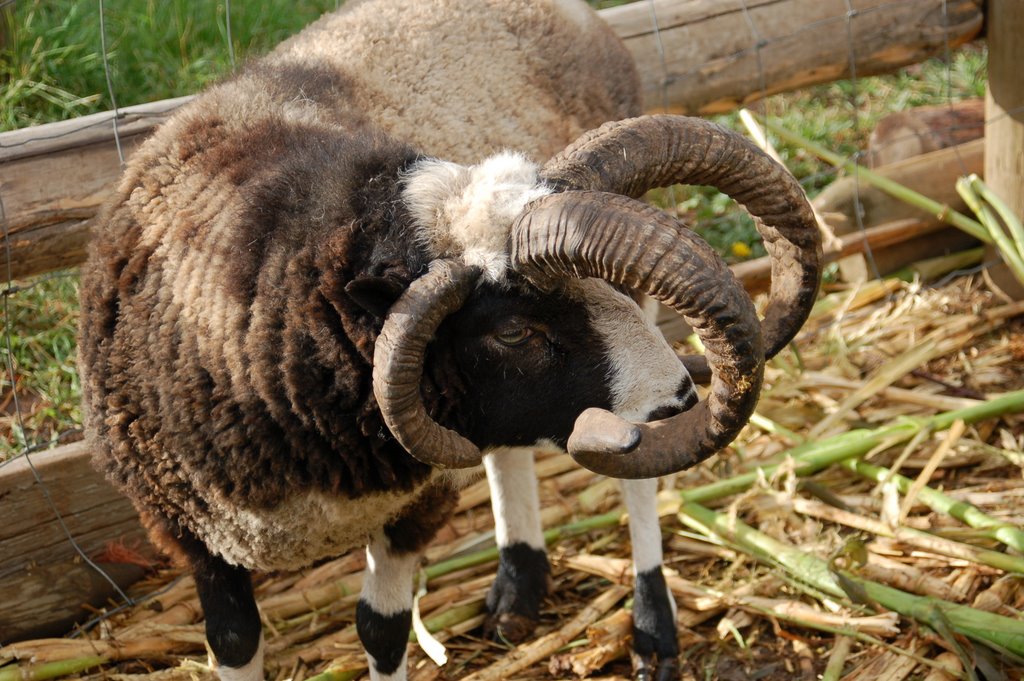 This ram got our attention by virtue of his four horns. The poor thing must feel like he's lived his life behind a hockey mask.
 What country scene is complete without a red barn?

There were also three little pigs!! The two shown in the photo were less afraid of the big, bad wolf.
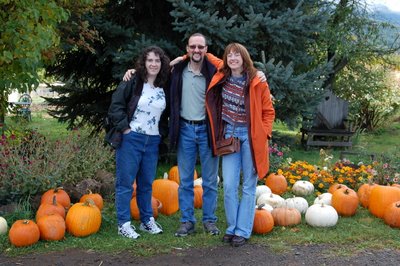
My friend, husband and sister make a charming group there amongst the pumpkins and marigolds, don't you think?

My sister certainly dressed for the occasion!!
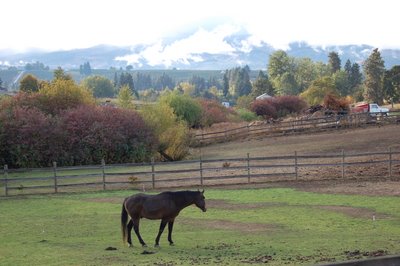
We all decided that the word bucolic, which is an adjective used to describe an idealized country life, was certainly fitting the environment, but it is not one of those words that sounds like what it means. It's really quite an ugly word used to describe such a pretty scene. The horse was very benevolent on the occasion, and graciously allowed us to pet it and feed it some of the grass from the other side of the fence. It was a very smart horse, because, of course, the grass was clearly greener on the other side.
I have discovered that my blog program doesn't want to let me post more than ten pictures at a time, so I'll put these out for you now, and work on a second post to give you the rest, and put it below. Hope you liked 'em.
Update: Oops!! I forgot to tell you that some of these were taken by me, but many of them are my sister's handiwork. I don't want to take credit away from her artistic eye, even if it is my blog and I could probably get away with it!!
Pics Two
Here we go again. I'll just treat this post as a continuation of the one above, okay? Charm, charm, charm. Here's another of our favorite autumn trek haunts. Rasmussen Farms is the home of "Pumpkin Funland," where pumpkins become characters in a set of comic tableaux, and Pumpkin Farmers take their crops to town. I'm not sure what it says about them that their crop is a load of pumpkins. Looking at it from a human perspective, it could be inferred that they're hauling a whole pile of heads off to market, a sort of "Pumpkin-man meets cannibal head-shrinker" scenario. That's a little too Halloween for my taste, though, and really, would cannibals have artistic enough souls to decorate their horse with flowers? I think not.
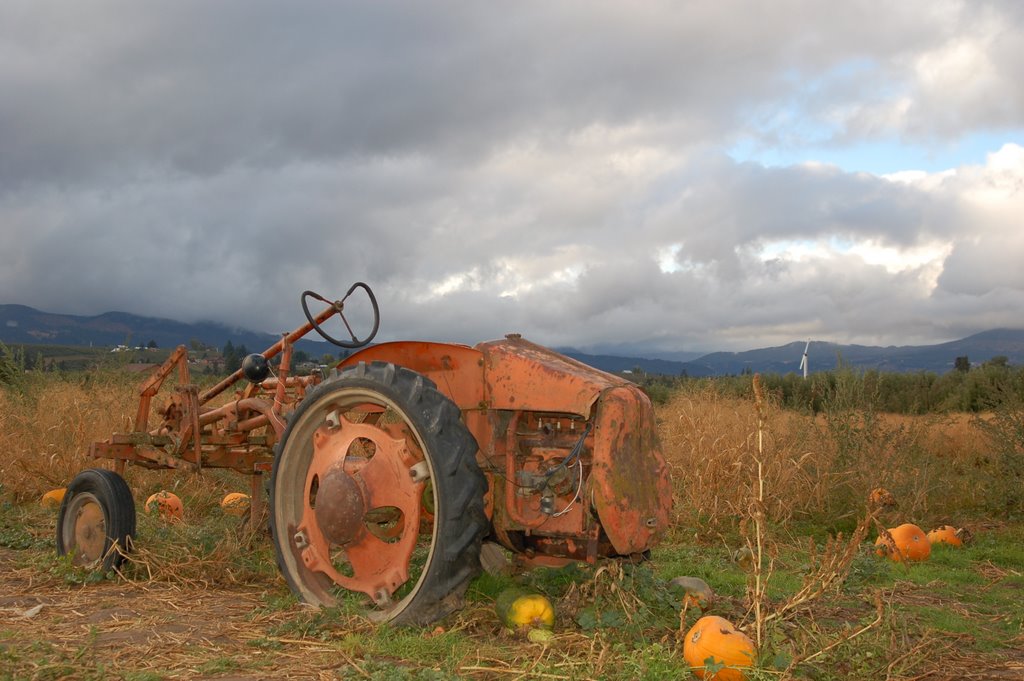 Does this picture bring the Green Acres theme song into anybody else's head? Bah dum, bah dum bum, Bum Bum...

Do you suppose that old tractor had anything to do with growing these pretties?
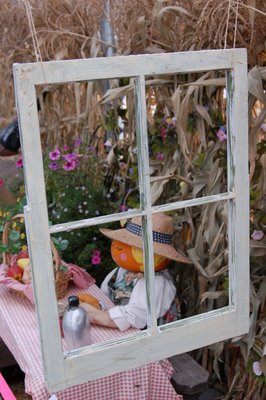
Inside "Pumpkin Funland" every year, they chose a theme and run with it. This year's theme? Then and Now. We only got a few photos, but the scenes were a progressive look at the way of things in bygone eras, contrasted to how things are done now--from dating, to sports, to travel, to math, they had an scene for everything--the funland concept of how complex calculations were performed in days of old? Gourdhenge, of course!!

Who doesn't remember Grandpa Pumpkin's tales of childhood tribulation?
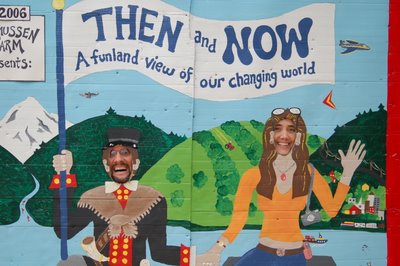
I think Ked and I are looking pretty sharp here, don't you? Maybe a bit two dimensional.

Every year we "ooh" and "aah" as we drive by this place. It looks like one of those perfect replicas they do at Disneyland. Doesn't this look like the perfect place to retire, or maybe open a bed and breakfast? Of course, we're a long way from retirement, but it never hurts to plan ahead.
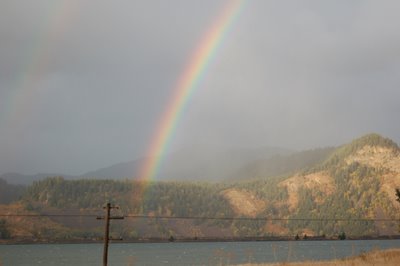 We thought the day ended on a rather pleasant note. We drove through a wonderful downpour, promptly followed by this lovely rainbow over the hills of Washington. All in all, the day turned out to be just about perfect. I can't wait till next year.
Tuesday, October 17, 2006
Federalist Iraq
Neo-neocon has an interesting post on federalism and the future of Iraq. She says, "The Iraqi Parliament has passed a law allowing for the establishment of federal regions in Iraq." This could enable Iraq to head toward a form of government resembling the early days of U.S. self-rule, with a relatively weak central gov., and strong states, in a sort of loose cooperative. The question is whether that country could prosper under a system which allows more autonomy to the three main regions of the country--Kurdish, Sunni, and Shia, or whether that would lead to the ultimate breakup of the country, or domination by outside forces like Iran. She makes a case for there being some plausible mutual benefits to cooperation for the various regions and factions involved. Have a look.
Tradition
Everyone needs a day off now and then. Everyone needs a break from their routine, and a chance to regroup. Ked and I have very few traditions, but one of them is our annual autumn day in the country. It is a refreshing pilgrimage, a sip from the cup of God's creation, a respite from the demands of daily life. Even when daily life isn't demanding much, our attitude can occasionally benefit from a step back to gain some fresh perspective, and in busy years like this one, where stress has been a frequent companion, that stepping back and taking a day to seek a little extra peace in the rush of life is all the more necessary. Leaving the city behind for a little while, we breathe in God's grace, full of gratitude that He has allowed us to live in a place so full of beauty that merely driving out into that world can rejuvenate our souls. We taste His favor.
Here in Portland, we are surrounded on all sides by some of the most glorious scenic wonders you can imagine. Rivers and mountains, hills and valleys, and rich, fertile farmland. If you head west for an hour and a half or so, you'll pass through the forested coastal mountain range, on your way to find long sweeping sandy beaches and rugged rocky shores. If you choose southeast for your direction, you will once again find your passage through dense forested foothills, which swell to become the majesty that is Mount Hood. Continuing on this path, past the beckoning ski slopes, will take you on to the open high desert, so different from the lush Willamette Valley, but equally beautiful in a stark and deceptively barren sort of way, with ever more volcanic mountains thrusting high above the desert plain to remind you that God's methods of creation are often turbulent.
This Sunday after church the road called us to once again experience some of the joy that is an autumn day in Oregon. Our journey was east into the Columbia Gorge, where just the view on the drive alone is worth the effort and time. The powerful Columbia River surged with the fresh fall rains, pushing stout white arms against the resisting wind. The towering Oregon cliffs, heavy with timber, danced their mountain dance, kissing their cloud companions with passionate abandon. The hills of Washington swelling from the opposite shore, peering out from the thickening mist, prepared to weather the gathering storm. All the red-gold colors of fall bravely shouted their defiance to the greyness of the rain, as if to say their splendor could be dimmed, but not extinguished, for their brief annual reign of glory. My soul takes refuge in such scenes as these. I need them. As much as I need food, air, or love, I need this kind of beauty, that man cannot create; he can only enjoy and try to emulate.
So, each year we go seeking this moment. Once every autumn we take the drive through the Gorge to Hood River, sometimes alone, usually with a very good friend. This year my sister joined us as well, for a day that has taken, over the years, a familiar and comfortable pattern. Hood River is a picturesque and charming village, with shops and restaurants suiting such a setting. Once there, we eat at a local bistro, and then we drive past the town itself to wander among the orchards, stop to pet the horses, and snap photographs that attempt to capture the artistic beauty of the multi-colored autumnal hills. We buy boxes of pears and apples at our favorite local fruit stands, and always look for a cheerful diversion in "Pumpkin Funland." We immerse ourselves in seasonal colors and smells and flavors. This is a day we spoil ourselves and waste time, and buy homemade caramels and eat them all before we get home. We savor their sweetness as we once again pass through God's natural art, on our soul-satisfied way back to Portland, tired from a long day, but content with our tradition.
This day is made more wonderful because it's only once a year, but also because it's every year. We will travel the same road again through different seasons. We will come this way in the winter to ski. We will come this way in the spring and summer to hike. We will pass through again at various times for work or play, but this one day each year is special. It is our pilgrimage and respite. It is our time to breathe. It is tradition.
Monday, October 16, 2006
A Soldier Remembered
Here's a very moving story of an American hero. Sometimes we toss that word around too easily. Sometimes, it's earned. Angelo J. Vaccaro earned it.
Saturday, October 14, 2006
Reality Check
If you ask me, mirrors are a curse. People worry far too much about how they look to other people, and mirrors only exacerbate the problem. People generally are way easier on us than our mirror is, but the mirror never tells us that. Mirrors don't tell us how we look to other people--they tell us how we look to ourselves. A self-critical person looking in a mirror will always focus in on whatever flaws they perceive and magnify them to fit their insecurity level of the moment. Mirrors often give us confirmation of our worst fears, regardless of what they actually reflect. No matter how clear the image, our minds can find ways to distort it. Women, especially, are prone to twisted thinking about how we look, where every extra pound becomes ten, and every fine line becomes a Grand Canyon of wrinkles. We might as well be standing in front of a fun-house mirror most of the time. Women are experts at making the most out of our flaws.
So how about a mirror that does the same thing for you, only better? Would you like a mirror where you don't even have to apply any imagination to see yourself at your worst, one that magnifies your flaws for you? Well, there's apparently one coming--a mirror that aims to be completely honest with you about what you'll look like if you keep eating a pint of Haagen Dazs every night, or smoking three packs a day, or laying around watching reruns of Gilligan's Island. You see, this mirror is linked to cameras all over your house, that watch everything you're doing, and report back to the mirror, which extrapolates that info about your lifestyle choices to create images of the new and not-so-improved you.
Doesn't that sound fun? Photoshop finally has a real purpose--making you feel worse about yourself!! Supermarket magazine stands and television aren't enough. You need more reinforcement of your physical inadequacy. Now, to be fair, maybe your mirror friend will go the other route. Maybe it will see you trying and cut you some slack because its network of camera spies sees you hitting the treadmill a couple times a week. Maybe it will show you images that make you look toned and fit and absolutely fabulous, but I ask you, WHAT'S THE POINT!!? It isn't real!! Mirrors can't predict the future, no matter how many cameras there are inside your refrigerator. This "motivational tool" looks like it can only beat you up emotionally, or make promises you might not keep. Keep it far, far away from me, please. I usually love techno-gadgets, but this one definitely goes on my "not in a million years" list.
Hat tip: Futurismic
Strong Statement
Great video at Blackfive. The Army's new recruiting slogan--Army Strong.
HT: Michelle Malkin
Friday, October 13, 2006
Dissent In Politics
We're heading into the home stretch for the mid-term elections--heavy duty political season. It seems like everyone has opinions, and candidates, and parties they support, or despise, or see as the lesser of two evils, or want hung from the nearest gallows. Individual politician's crimes and offenses are made out to be giant party trends (sometimes accurately), and having the upper hand and jockeying for moral victory get oh so much more important as we approach election day--at least jockeying for the appearance of moral victory. For many candidates, it's all about landing blows on the opponent, and not about saying, "Here's why my ideas are better than the other guy's." Improving poll numbers are the political holy grail, and contribute to the momentum that will carry the party on to victory. Or not.
I wonder how much of that momentum is based on all the hype and accusations that come out just before the votes are cast. Are Americans really so fickle that the latest sex scandal, or shady land deal, will push the electorate over into one camp or another? Do most of us care enough to get educated about the issues and vote responsibly? Do we care enough when not inundated with the high drama of the peak of the election cycle to pay attention to what politicians really do--how they vote after all the promises that get them elected? When we discuss politics amongst ourselves, is it with an eye to finding the best solution, no matter who comes up with it, or are we so entrenched in our beliefs about other people's motivations that we won't even listen to their explanations and ideas if they happen to be of the wrong political persuasion?
I'm not sure about the answers to all these questions. I'd like to believe that the average American is better than the politicians think them, and not as vulnerable to the "October surprise" as all the final posturing in the last days of campaign season would indicate. Most of the people I know are pretty reasonable (most, not all), but why would the politicians and their minions bother with the last minute "gotcha" games if they weren't at least a little effective? Also, why does it seem that so many people aren't interested in even hearing the opposing point of view? Do they not think any good can come from getting another perspective? I don't know. I do know there's an awful lot of shouting each other down, and this year, as is common in recent years, there doesn't seem to be nearly as much discussion about ideas as there are proclamations about how horrible the other side is--and then offense when the other side takes the same approach and declares them horrible in return. I have a friend with political leaning bosses who think it's perfectly fine to let their employees know where they stand, but it's strictly verboten for anyone else to share an alternate perspective. How is that right? These days, the common interpretation of free speech so often seems to be, "feel free to agree with my speech." It's frustrating.
Peggy Noonan has a look at this squelching of dissent in a Wall Street Journal editorial. She is writing from a conservative perspective, and so her examples are all from the left. I think she has good reason for her perspective, but I do think she could have listed some examples from the right as well. I don't think this is an partisan issue. It's an issue of civil discourse. It's not about Democrat or Republican. It's about being civilized people. Have we entirely forgotten how to have a reasonable political discussion? I see a lot of evidence that the art is fading fast, but I hope that those of us who aren't so married to our ideas that all thought of disagreement makes us livid can still move to change that pattern.
Feel free to tell me your opinion on this one. Am I just getting a skewed image of this? Is there more civilised discussion out there than I'm seeing? (Outside of the blogosphere, that is. I see lots of good discussion happening here.)
Hat tip: Instapundit
Thursday, October 12, 2006
The Force Is Strong, And It's Messing Up Our Calculations
Some people are way too smart. It's almost scary the things that these especially astute people can think through with their mighty Super Brains. How many of us really understand what Einstein's Theory of Relativity is, and why we should even care, let alone grasp the math required to prove it? Up front I'll say I certainly don't, and if you do, you had probably better go read somewhere else, because this post is waaaaay beneath your abilities. I like to skim the surface of science for fun. I am enough of a geek to get a kick out of scientific theory and technological development, and I even did the extra credit geometry problems for fun in school. (My teacher didn't give the extra credit, so I guess that tilts me a little farther into the geek category.) However, I went on to be a Lit major, not a Smart Person, so I just get floored with the things that some people are able to figure out.
I have been at the European Space Agency website this morning, and not only do these people understand Einstein's theory, they are heading out into space to test it and "lay the foundation" for further developing its concepts, also potentially enlarging their knowledge of gravitation and navigation in the process. By navigation I am, of course, referring to space navigation. I don't think the European Space Agency is worried about directing ocean liners and weather balloons. They're interested in directing space ships, and calculating the huge distances between heavenly bodies, and figuring out how much gravitational pull those planets, and stars, and black holes, etc., are going to have that could pull probes and ships off their intended course. The weather balloons will have to fend for themselves.
Since we're talking space and astronomical bodies, there is a basic question about how you account for the movement of these bodies when calculating distances and locations--of anything. If two items are both moving, there has to be a way to measure that motion. Apparently, this involves bringing another object into the mix:
A cornerstone of relativity is the concept of a frame of reference. This is a set of bodies relative to which any motion can be measured. Without a reference frame, no motion through space can be detected. Scientists call a frame of reference 'inertial' if unperturbed objects appear in that frame, either at rest or moving at a constant velocity. For a reference frame to be perfectly inertial, the bodies that are used to mark it must be completely free of any force.If I'm reading this right, scientists can measure things accurately in space only if they have objects to which they can compare other item's motion--objects that are either completely still, or are moving at a completely constant rate, but without being affected by the pull or push of anything else. They then can measure the motion and distance of other bodies relative to these celestial touchstones. The problem the ESA is facing is that gravity from all those big celestial bodies out in the great beyond is always mucking up the works, and its very difficult for any frame of reference to be "free from any force," so the measurements get all out of whack.
So, what is the ESA doing to overcome these difficulties? They are working to create their own frames of reference, and compensate mathematically for the "warping" of the measurements of distance that happens when gravity is not properly taken into account:
To make this measurement, LISA Pathfinder uses two 'proof-masses'. Each is a small cube of a gold and platinum alloy, whose relative motion is measured by a laser beam. Once in space, the proof-masses will float freely within the spacecraft. When subtle forces act on the proof-masses, the laser beam will detect the way they change position to within a few thousandths of a billionth of a meter, and will be able to detect forces as small as the weight of a typical bacterium.In layman's terms, or as close as I can come even to that low standard, they made these gold and platinum alloy cubes (only 5 centimeters wide) because they are as close to being impervious to magnetic fields as they could possibly get them, since that is another force which can act on objects out in space. They have made them this way so that the only force they will respond to is gravity, and they hope to send them out into space, free-floating in this vessel called LISA Pathfinder. Then the fancy extra-accurate laser measuring gismo will track their every motion. In this way, they hope to detect and calculate the gravitational forces that throw off the accuracy of space measurements, and then they'll do lots and lots of complicated math to work out how much distance is really between all those celestial bodies that are currently way beyond our reach, but we might get to once the Smart People figure out warp drives.
The date they're shooting for to send LISA Pathfinder into space is sometime in 2009. This mission is the forerunner to LISA, which is a bit more large-scale, in which, "three spacecraft...will work together to detect Einstein's predicted ripples, known as gravitational waves, in the fabric of spacetime." Okay, I'm barely getting my head around the concept that these people can do the math involved in compensating for gravity when calculating distances in space, now they want to start looking for ripples in the fabric of spacetime. I think I'll ignore this part. I can only handle one over-my-head topic at a time, thank you very much. All the same, the Super Brains are really amazing, don't you think? I wonder what they'll work on once they have all this space measuring and navigation stuff figured out? Probably those warp drives we're going to need once they have the navigation part down. Whatever it is, I'm sure most of us won't understand it. I think I'll go read some literature now.
Wednesday, October 11, 2006
Sure It's The Economy, But Which One?
I don't have lots of time to write today. Maybe I'll get the chance in the evening, but in the meantime, I thought I'd toss this Wall Street Journal piece, by Edmund S. Phelps, your way. It explains the difference between the North American and European economic models--capitalism versus a "social market economy." It's a very interesting read, if you're into learning about economics. I clearly am, or I wouldn't be passing it on to you. Anybody else economically minded?
Hat tip: Instapundit
Update: I just read in the comments on the article at the WSJ site that Professor Phelps just won the Nobel Prize for economics on Monday. No wonder the piece is so good!!
Tuesday, October 10, 2006
Please Let This Be Wrong
Syria prepping for war? Looks that way. Nobody's surprised that Israel is on the alert, right?
Hat tip: IMAO
Battlestar Galactica
Not sure how many Meow readers are Battlestar Galactica fans, but there's got to be one or two, so I'm going to feel free to write about it-- not the dated but nostalgic version of the seventies, but the new edgy, pushing-the-envelope version that the Sci Fi channel has been bringing us for the last couple years. Ked and I are always willing to give anything sci fi a try, so we have watched Galactica since its pilot episode, and have been very impressed with the quality of the writing, acting, production, you name it. "Sci Fi Friday" has kept us watching thus far, although, we have been a bit shocked at times, I confess. We don't watch R rated movies, and are rather un-desensitized to the sex, violence, and language that Battlestar's writers seem to think necessary. (They've come up with new swear words, but, please, who can't figure out what "frak" is supposed to mean?) We've let some of the things we don't like slide, because Battlestar crew have created such a believable and interesting world, and the quality has been so high. It's always been on the outer boundaries of our limits, though, and we are aware that, if it keeps pushing, the show may soon get to the point where we are no longer able to overlook our discomfort as it seeks to walk the bleeding edge.
The season premiere was last weekend, and we wondered again whether we will be able to watch the show much longer. The season opener was intense and very graphic, but more than that, it seemed far too interested in addressing things which are going on here on Earth, instead of in space, by the approach they are taking to the current plot line. Most of you will remember that the earlier series was all about these humans fleeing the Cylons (robotic machines), and searching for Earth. Well the new one is a similar premise, except the Cylons now look human, and during the course of the last season, the human refugees found an inhabitable planet and many of them settled on it. This is where they get a little too close to current events.
The Cylons, of course, discovered the human colony, and now the settlers are carrying on a resistance war against a Cylon occupation. The Cylons claim to be benevolent, but are oppressive, with human collaborators arresting people in the middle of the night, torture chambers, suicide bombers forming the resistance, and a puppet government. Remind you of anybody's view of Iraq? It wasn't all black and white, however. The good and bad characters were pretty well mixed amongst human and Cylon alike, and true to previous Battlestar form to date, it stayed away from pat answers and platitudes. I'm willing to give the producers the benefit of the doubt that they're not trying to shove a particular view of Iraq down anyone's throat, but it does make me wary.
I don't mind politics to some degree, but I do hope the show doesn't get too agenda driven. I can't continue to watch a series that continues to push my "I can't watch that" buttons, in terms of sex and violence, and then also pushes an agenda that I can't agree with. I sometimes can ignore one or the other, within limits, but not both, and not for any length of time. So, we've been in debate. We have one friend who has told us she will no longer be watching the series. Ked and I have been willing to give it another episode or two. When the series began it starting out at level of "I can't watch that" that backed off after the initial bid to snag viewers. We are hoping it will do so again. If the whole suicide bomber theme continues, and "Cylon" become a code word for "the Bush Administration and its evil military hordes," however, it will lose us altogether. To quote a line from As Good As It Gets, some things are just a little too much reality for a Friday night-- somebody's version of reality, anyway. Not mine.
I read a piece at National Review Online that gave me a little hope, though, that the series may not go down a path we're not willing to follow. Jonah Goldberg discusses the season opener, and the next few episodes coming down the pipe, and it looks like the show isn't going to follow the Iraq parallel as it progresses. Good. There are a lot of loyal sci fi fans out there who are also loyal Americans, and don't see our role in Iraq as a Cylon occupation. Now if we can see them back off the graphic visuals, we can salvage our ability to watch one of our favorite shows. Intelligent science fiction is a balm to some of us who can't stand sitcoms, night-time soap operas and propaganda dramas, overblown documentaries about the "real Jesus", and all the other common fare that television has to offer. They've already taken away Firefly. I hope we don't have to abandon ship on Galactica.
Hat tip: IMAO
Monday, October 09, 2006
Climate Science--Emphasis On Science
A friend asked me to keep an eye out for articles about climate science (emphasis on the science, and not the hype.) I'm happy to oblige. It's a topic I keep an eye on anyway. Beside the fact I have a genuine interest in the state of our planet, both the alarmists and the total naysayers have their entertainment value, after all. However, I frequently can give little credence to what I read, because so little of it is based on experimentation, and so much of it on anecdotal evidence and politics.
At first much of the debate rested in whether the Earth is warming at all. Then it shifted to the cause, as weather records over the last few decades do show a decided warming trend. Some people are still heavily engaged in the "why" debate, but many have moved on to what, if anything, we should/can do about it. Much of the world has simply accepted--It's Our Fault. Eliminate humans and you eliminate the problem. (Making the assumption, of course, that it is a problem.) Since ridding the world of humanity is hardly practical, the next best solution offered by some is to make people stop living the modern life, something very few of the uncooperative scourges of the Earth are willing to do (except the ones who want to take us back to the seventh century, but that's a different topic altogether.) So we spend a lot of time blaming and very little time checking our facts.
Sometimes, however, we get a look at actual verifiable science on the topic. It's very refreshing. Here's an example. SpaceDaily has a look at experiments performed in Denmark that conclusively link cosmic rays to cloud formation, and thus Earth's temperature:
Here's the lowdown. Scientists filled a large reaction chamber with the appropriate gases to approximate the chemistry of the lower atmosphere. They used ultraviolet lamps to perform the function of the Sun's rays in the equation, and as the "penetrating cosmic rays" did their thing, the scientists monitored the chemical reactions in the chamber with instruments that only "really smart people with degrees and stuff" know how to use. The experiment proved that cosmic rays help facilitate the development of the "stable, ultra-small clusters of sulphuric acid and water molecules which are building blocks for the cloud condensation nuclei. A vast numbers of such microscopic droplets appeared, floating in the air in the reaction chamber." Turns out the rays are very effective at producing these building blocks, and there is now empirical evidence that cosmic rays can have an effect on Earth's climate because of the clouds they help form.It is already well-established that when cosmic rays, which are high-speed atomic particles originating in exploded stars far away in the Milky Way, penetrate Earth's atmosphere they produce substantial amounts of ions and release free electrons.
Now, results from the Danish experiment show that the released electrons significantly promote the formation of building blocks for cloud condensation nuclei on which water vapour condenses to make clouds.
Hence, a causal mechanism by which cosmic rays can facilitate the production of clouds in Earth's atmosphere has been experimentally identified for the first time.
It's interesting how that works. The more rays that get through to Earth's atmosphere, the more low-altitude cloud cover we get. Less rays equal less clouds. Those low altitude clouds drop the temperature here on Terra Firma. Here's the really intriguing bit:
Did you catch that? When the Sun's magnetic field is strong, we get less cosmic rays. Therefore, one can conclude that when the Sun's magnetic field is strong we get fewer clouds, and the Earth warms. That would link global warming to the cycles of the Sun, wouldn't it? I have read the theory before, and seen data that clearly showed that over the last four hundred years, as the Sun has cycled, so has Earth's temperature, and this experiment is some solid support for that theory. Unfortunately, I can't remember where I read the theory in the first place, but hopefully the SpaceDaily article will give you a good start on the subject.Interestingly, during the 20th Century, the Sun's magnetic field which shields Earth from cosmic rays more than doubled, thereby reducing the average influx of cosmic rays.
The resulting reduction in cloudiness, especially of low-altitude clouds, may be a significant factor in the global warming Earth has undergone during the last century. However, until now, there has been no experimental evidence of how the causal mechanism linking cosmic rays and cloud formation may work.
I still think, of course, that we need to follow all the scientific leads, and find out for sure whether humans really are effecting the climate, or whether natural cycles such as the flux in the Sun's magnetic field are the reason for the temperature shifts we experience over the years. I don't think, however, that we ought to be making rash decisions that shut down the economies of the world because of fears that are as yet unproven. If global warming is a temporary and natural phase of the planet, caused by forces as far away as the Sun, no amount of turning off the air conditioning, riding the bus to work, or staying off of airplanes is going to change that natural rhythm. Of course, theories come and go. I remember being warned as a child that we were going to enter another ice age soon. We see how accurate that prediction turned out to be. I'm all for scientific investigation of the facts, but histrionics are pointless. I read recently that Al Gore told a group at the U.N. that cigarette smoking is a significant contributor to global warming. You tell me which of these two theories--cigarettes, or cosmic rays as realistic causes--has the most likelihood of veracity? Until I see solid scientific proof that smoking is the cause, I'm sticking with cosmic rays.
Hat tip: The Anchoress
Sunday, October 08, 2006
Trust? No--Verify
I'm awfully fond of TCS Daily, as some of you know, and find a good deal of intellectual fodder amongst the many and varied perspectives on technology, commerce and society which fill its electronic pages. Much of it is rather libertarian, with the occasional conservative twist, which suits me fine, and the authors are as diverse as the topics. I head there frequently. One of my favorite TCS authors is Dr. Henry I. Miller, and I have posted on his articles more than once. He writes about things that interest me; medical research, medical trends, biopharming, bioengineering and the like. Frequently, not surprising in a publication with a libertarian bent, I've seen him criticize government over-regulation in scientific matters. From the development of new drugs and treatments to gene-splicing, he usually comes down in favor of letting science come up with the best options possible, and scientists and scientific testing, rather than bureaucrats, judge their efficacy. From what I've read, I've gathered that he believes that over-regulation slows needed medical progress. I fully agree. (Note: I said over-regulation, not all regulation.) So, when I started reading an article in which Miller started calling for more regulations, I took note.
The problem he's addressing in an article titled "Are Bad Drugs Coming to a Pharmacy Near You?" is the growing number of counterfeit pharmaceuticals making their way into the medicine chests of the unsuspecting. According to Miller, it's a problem worldwide, and consumers in the U.S. are by no means exempt:
Although quantitative estimates are difficult, it appears that something on the order of ten percent of the world's drug supply is counterfeit, encompassing not only products that are completely fake, but also those that have been tampered with, contaminated, diluted, repackaged or mislabeled in a way that misrepresents the contents, dosage, origin or expiration date. The World Health Organization estimated in 2003 that as much as five to seven percent of all drugs sold in the United States may be fraudulent in some way.Mafia and terrorist groups, drug cartels and other such nefarious do-badders make a huge profit producing knock-offs and slipping them through the vast and confusing pipelines that eventually bring them to that pharmacy near you. Actually, though, what's more likely, says Miller, is that they are coming to a pharmacy not near you, but that the chances you're going to get less than you "bargained" for go up when you try to save money by buying medicines from outside the country, especially online:
How do fraudulent medicines enter the drug supply? Primarily by counterfeiters taking advantage of an alternative to the mainstream pathway of pharmaceutical manufacturing and distribution through which drugs normally move linearly from manufacturer to distributor to pharmacy to patient.He adds:
Increasingly, consumers are making the counterfeiters' job easier by buying drugs abroad. In a 2003 operation, spot-checks by the FDA and U.S. Customs Service found that 88 percent of drugs imported into the country by mail or courier violated federal safety standards in some way.The risks here are obvious. Diluted, out of date, or outright fake medicines aren't going to perform as required. I'm sure you will agree that this could be a slight to serious problem. The slight problem may be self-correcting. For example, I have a medicine I take daily for chronic pain. If my pills weren't doing their job, I'd probably figure it out soon enough and see my doctor for an alternative. This could cause me discomfort, and inconvenience, but is unlikely to cause me any real harm. My mom, on the other hand, has a heart condition, and medication that she must take daily, without fail. What if the drug she takes was replaced with a replica, indistinguishable, but ineffective? She might not have any warning symptoms that the pill she was faithful to take wasn't doing its job until her heart wasn't doing its job either.
So, by Miller's account, what is the solution to this dilemma? I think it's worth quoting him directly again:
I'm surprised to find an area in life which I actually agree could need more regulation. That's not an easy sell with me, but Miller makes the case quite successfully that this is a matter of public safety. It's important that we know what we're getting, and that we can trust the source. In order to trust it, we need to know what that source is. Fortunately, as Miller explains, there are improving technologies which can help in the quest for reliable tracking and content verification methods. These, no doubt will add to the cost of popping prescription pills. So be it. I'm not a spendthrift kind of gal, and I do part with my money reluctantly, but this revelation that some of our pharmaceuticals may come from "mystery manufacturers" and be "fake pharma" has certainly made me more inclined to value safety over price.First, Congress must increase the penalties for drug counterfeiting, and the FDA must more aggressively enforce regulations that require documentation of the "pedigree," or history, of a drug as it moves through distribution channels.
Second, we need to apply new track-and-trace technologies to uniquely identify and track the distribution of drugs. (And similar to our confrontations with dealers of illicit drugs, in order to keep ahead of the bad guys we will have to innovate constantly.)
Third, new authentication technologies, such as holograms and ultra-violet and forensic tags, must be developed to make it more difficult for counterfeiters to imitate legitimate drugs. A promising new technology would attach mixtures of pH-sensitive fluorescent dyes to drug molecules and measure changes in fluorescence in the presence of solutions of different compositions.
Fourth, when making Internet purchases, consumers should patronize only pharmacies on the National Board of Pharmacy's recommended list ( www.nabp.net/vipps/consumer/listall.asp).
Finally, consumers should be vigilant for anything amiss in any prescription drug obtained anywhere - unusual color, texture, markings or packaging and, when feasible, for any differences in effectiveness or side effects.
The Times They Are A-Changin'
But is that a good thing? Here's a bit of perspective and history on women wearing the hijab in Muslim countries, from Big Pharaoh.
Saturday, October 07, 2006
Pics In Space, Again
Hey Gang, it's that joyful time we all look forward to with the knowledge that it will brighten up an otherwise gloomy day, and add a sparkle to really nice ones. Remember? That joyful time... It hasn't been that long, has it? Come on, you know what I mean--the Meow has a link to the new space photos!! (As usual, just click on "see the slide show.") Every month MSNBC.com goes to the trouble of putting together a slide show of recent space-related pictorial delights, and every month, I take it upon myself to bring them to you. Isn't that nice of me? Isn't that nice of MSNBC? Isn't it nice of the people who snapped the pics so that those of us who don't happen to live in places where we can see space shuttles take off, or have a way to glimpse the crew spacewalking around the International Space Station, view Crater Lake from the ISS, or marvel at the rings of a crescent Saturn, can still feel a part of the wonderful world that's "out of this world?"
This month's offering has a gem, or two, and you won't want to miss them. One that I found particularly inspiring wasn't actually a photo from, or of, space. Some of you may know that recently an Iranian-American women went as a paying passenger to the ISS. Anousheh Ansari paid an estimated $20 million to be the first woman to buy the privilege of a trip into orbit. Here's her blog. Definitely read her blog. It's fascinating, and I found I couldn't stop reading. (It was a tad confusing, because the entries are on individual pages and come up in reverse order to time, but once I discovered the little calendar on the right side of the page, I just started calling the posts up by date, which straightened things out for me.) As engaging as her story is, however, the picture this month which inspired me and got my attention the most wasn't of her, or things she saw; it was a group of young Iranian women pointing into space with joyous enthusiasm as the ISS passed over Tehran, carrying Ansari, on September 23rd. It just does my heart good to think of young Iranian women dreaming of space, and seeing what a woman from Iran has accomplished. (Seeing them all swathed in black tents while the boys were wearing comfortable t-shirts is another story, but at least the girls were there.)
Like lightning? There's a real "finger of God" kind of image awaiting you. Like big toys? Have a look at a Soyuz rocket booster. Like geography and geology? Go gaze at some of the amazing sights to behold on Venus and Mars. The aurora borealis is pretty spectacular from the ISS, and a hurricane looks just like a flowing white skirt from the shuttle Atlantis, but the prettiest picture from my point of view is the image snapped by Hubble of the fragments of a supernova. I think that one gets my vote for best photo this month. There's more to see and enjoy in our little monthly diversion into the realm of space photography, so have fun. Then come back and report on your favorite image--or not, as your spirit leads. Space is all about flying free, as far as I'm concerned, so by all means, go where the lack of gravity takes you.
Friday, October 06, 2006
The Politics Of Improving Security
Michael Rosen, at TCS Daily, has an interesting analysis of a convergence of benefit between successful politics and good policy. Specifically, he has a look at gains made over the last few months toward improvements in homeland security, including the 700 miles of border fence recently passed by both the House and Senate, as well as legislation establishing military tribunals for terrorism detainees and basic standards for interrogation of combatant prisoners. There are clear advantages to both achievements. The fence, as I've noted earlier, is about knowing who's coming into our country. Setting tribunals and interrogation standards gives guidelines for CIA and military questioners, protecting both the detainees (from abuse) and the interrogators (from unjust accusation.) Rosen points out that, with an election looming, these accomplishments are beneficial to Republicans politically, as the party in power, but says that "the U.S. as a whole is the true beneficiary." Have a look.
Pretty And Practical
Hey, here's an idea that's pretty neat. I read last June about a concept being developed in Scotland, in which roadways would be used as power collection stations, and how heat absorbed throughout the day by the blacktop can be converted to power and stored for later use. I thought that was a promising development, since there are an awful lot of streets soaking up the sun's rays year round. Now there's another cool idea for the "fun things to do with roads" list. A team of Australian engineers has come up with a new way to turn roads into water collection and purification systems. Anna Salleh writes for Science Online that they are developing a new kind of porous paver, designed to take advantage of the fact that so many urban surfaces are roads, driveways and paths--about sixty percent of them. Rather than letting these surfaces shed rainwater runoff into waterways, and taking road pollution with it, the pavers would allow the water to seep through them, filtering it in the process by means of additives, microbes, and granulated activated carbon, and then sending it into underground storage tanks. Such water stores could then be used for irrigation, cleaning and the like. Not bad, eh?
One side effect of this alternate to standard concrete or asphalt is that trees planted nearby would also benefit from access to more water and air. Chalk this one up in the "good side effect" category. Happy trees are always a nice thing. The pavers could facilitate other greenery, as well. The article mentions that the pavers "can be seeded with low maintenance native vegetation." I assume this is in low traffic areas. I get the image in my head of a village somewhere, with these special concrete pavers laid out in pretty patterns and lovely Scotch moss weaving its way throughout as part of the effect. Makes me want to go there--wherever there is. Of course, the added bonus comes when you discover that the road isn't just lovely, it's also supremely functional as well, and provides a goodly share of the town's water. Pretty and practical are such a great combination. Lest you fear that a road doing extra duty as a water-gatherer won't hold up as a road, the pavers are reinforced with a special "bonding material" so they can take the weight from cars and trucks. Pretty, practical and strong--everything you ever wanted in a road, and more.
According to Salleh, a full-scale prototype is about to be built. I think the heat gathering system in Scotland is likely well under way, too. If both of them succeed, the streets of the future will be doing a lot of multitasking. "Roads: they're not just for driving anymore." Now they filter water and run your refrigerator, too!! I suppose the two systems are mutually exclusive. It probably wouldn't be practical to collect both power and water from the same roadway. At least, if they try, it would behoove them to make sure they don't cross the streams. Who knows, though? Maybe those underground water tanks could be filled on the rainy days, and then heated on the sunny ones. People are so inventive; I wouldn't put it past them.
Hat tip: Futurismic
Wednesday, October 04, 2006
Wow!!
Okay, I wasn't going to blog this--I was just doing a little reading for my own pleasure, but I said "Wow!!" so many times that I had to pass it on. Popular Mechanics November issue has its "Breakthrough Awards" for 2006, in an article written by Logan Ward, and some of the winners are really astounding. Anyone who reads the Meow will not be surprised that my favorite breakthrough was the nanotech innovation. I am a fan of all things nano, and have written about enough of the future miracles and current achievements that some of you probably get sick of the topic, but what they're doing is so cool I know you'll be enthusiastic too. Ward writes:
If that doesn't make you at least a little giddy for the fun and adventure that is nanotechnology, well, I don't know what to say. Perhaps science just isn't your thing, and you should read farther down the page to other Meow posts where the topic is more political. I will warn you, though--science, technology, and science fiction rear their lovely heads frequently around here, so if you keep reading, you won't be able to avoid them for long. As for those of you who get just as happy as I do at a good examination of the future of space flight, or a glimpse at the hope of growing human organs in a lab, the PM article is right up your alley, and sure to be a fun way for you to spend a few minutes of your time. Enjoy...THE GOAL OF nanofabrication is to make tiny machines build themselves using molecules they grab from their surroundings. It's easy to dismiss the concept as science fiction — or hype. Until you hear what's been going on in the lab of MIT materials scientist Angela Belcher, a star in nanotechnology circles.
Working with colleagues Paula Hammond and Yet-Ming Chiang, Belcher genetically altered a virus, the M-13 bacteriophage, inducing it to grab a pair of conductive metals — cobalt oxide and gold — from a solution. As the viruses rearrange themselves, they form highly aligned organic nanowires that can be used as a lithium-ion battery electrode — one so densely packed it can store two or three times the energy of conventional electrodes of the same size and weight. So far, the team has grown an anode. The next steps-which could be completed in two years-will be to grow a cathode, and to perfect the Saran Wrap-thin polymer electrolyte that separates the electrodes.
"What we want to do is have a beaker where you mix everything together and out comes the functional device," Belcher says. "Toy boxes often say 'some assembly required.' These will be no assembly required. My dream is to have a DNA sequence that codes for the synthesis of any material you want to make."
Hat tip: Instapundit
Terrorist Correspondence
Austin Bay, writing at Strategy Page, has a fascinating look at intelligence gained after the death of Al Qaeda's leader in Iraq, Abu Musab al-Zarqawi, in June of this year:
Bay analyses what we can learn from this correspondence, and the importance of such releases of information to the American public (and the world) in this age where media is part of the battlefield in war. The winning of "hearts and minds" occurs largely on this field, as does the waxing and waning of our backbone as a civilization to face the task at hand. Bay points out that dictators and terrorists for the most part can "control their message," something that is not the prerogative of Western governments. We don't see anything but bravado and supreme confidence emanating from those messages which Al Qaeda sends to the world at large. The letter is a "talking amongst themselves" moment, and really reveals a lot about where Al Qaeda actually thinks it stands these days, and should be encouraging to anyone who hopes that Coalition efforts are bearing fruit. Have a look.On Sept. 18, Iraqi National Security Advisor Muwaffaq al-Rabi released a letter from al-Qaida commander "Atiyah" (a pseudonym) to Zarqawi. West Point's Counter Terrorism Center (ctc.usma.edu) has the letter archived online.
The letter features al-Qaida's usual religious panegyrics, but also contains strong evidence of fear, doubt and impending defeat. It seems five years of continual defeat (and that is what the record is) have shaken the 9-11 certitude of al-Qaida's senior fanatics.
Hat tip: Instapundit
Tuesday, October 03, 2006
Political Scandals
This is by no means a blanket statement, and I don't think it's always, or completely, true. However, I think that in general I would take the following as a consistent rule of thumb. When there is a scandal, with admitted wrongdoing, or inappropriateness, involving political figures, the criticism breaks down two ways.
1) If the guilty party is a liberal--the conservatives will condemn the offense, while the liberals will defend the offender.
2) If the guilty party is a conservative--the conservatives and the liberals will both condemn the offense and the offender.
I've seen it repeatedly, and the current scandal involving inappropriate behavior, in email exchanges, from a Republican Congressman toward underage Congressional pages follows the same pattern. Both the left and the right are criticizing the now-former Congressman, and rightly so, although an FBI official quoted by The Washington Post, said the email activity was not criminal. I think it should be noted, in fairness to all those people on the right side of political punditry and politics, that conservatives are not giving the Congressman a pass because he votes the way they want. I'm sure there has been some ignoring of warning signs going on, which also should be condemned, but at least now that they know what's been going on, they aren't finding ways to justify the behavior, or blame the accusers. The Congressman is out. He resigned with a statement that he accepts full responsibility for his actions.
As substantiation for my point of view, I will just throw out some names: Packwood, Condit, Clinton, Jefferson, Lott. These are just a few.
Update: I'm feeling the need to explain that I'm not trying to be unfair here. I just really get frustrated when partisans take things like this and manipulate them for political ends. That's what I see going on now. There are politicians and pundits trying to take this situation and turn it into the newest reason why Republicans as a group are unfit for office. What I'm trying to point out is that the Republicans are not being hypocritical about this; it's just as bad to them when a conservative does something like this as when a liberal does. That is frequently not the case when the situation is reversed.
Space Shopping: Getting The Goods To Market
So, when we finally get hundreds of people living in "The Space Station of Tomorrow," how are we going to send them supplies? People have needs, you know, and as far as I know, Wal-Mart hasn't yet opened any new stores in orbit. (This is probably due to objections, which will one day be filed with the space station governing council, by concerned station planners, who want to protect mom and pop space ventures, ensure an adequate rate of pay, and prevent traffic congestion. It's probably already on the court docket for the year 2027.) Since a handy department store is currently out of the question, space visionaries had better start looking for another solution. Now, I grant you, there's going to have to be a whole lot of self-sufficiency going on. All those intrepid adventurers are going to have to forgo squeamishness about enhanced recycling of everything, from vehicle parts to human waste. It goes with the territory, but realistically, even in a Utopia of recycling efficiency, things wear out. Computers, clothing, gaskets and gadgets all have a limited lifespan. How is the provident home-world going to get the necessary care packages out to her wandering children? Sending rockets and shuttles one after another is too cost prohibitive. There's got to be a better way.
Would a giant circle of superconducting magnets do the trick? No doubt, most of us have asked that question at one point or another. Well, the U.S. Air Force has commissioned the answer, and David Shiga has written up the results of the preliminary study, in New Scientist Space. Boiling down Shiga's explanation--put a sled on the huge round track, 2 kilometers across, with cargo encased in a cone-shaped shell, and head to the races. The idea is that magnetic forces would gradually, over a period of hours, increase the speed of the load to about 10 kilometers a second, and then divert it into a launch tube, where a ramp set at thirty degrees would send the cargo flying. Friction from the tunnel would slow the cone down a bit, but not enough to keep it from breaking orbit. A rocket on the back of the cone would add steering ability. Easy as pie. Mind you, everything sent this way would have to be durable goods, be it satellite, food and water, other essentials like chocolate, or even weapons (this is the Air Force, after all.) We're talking 2,000gs of pressure here. Yes, I said 2,000 times the pressure of Earth's gravity, so this is strictly an inanimate object kind of transport system. Anything living that tried to hitch a ride wouldn't survive long enough to complain about the turbulence.
The preliminary study was encouraging enough for the Air Force to fund the next round of inquiry. This time it's a two year analysis, and hopefully will look more in depth at the healthy list of possible obstacles, chief among them being the atmosphere itself. There is the potential that overheating and trajectory difficulties from friction and wind could make the scheme unworkable. The team involved with the research is optimistic, however, that these problems are solvable. If all goes well in the next phase of study, the team hopes to build a small prototype of the ring to further test the feasibility of the concept. After that, they look for funding for the big kahuna.
Another notable concern about the project is that, with it's capacity to aim weapons anywhere in the world, the launch ring could itself become a primary target. That's understandable; I doubt the rest of the world would be happy about the potential weaponization of the launcher. However, that's what treaties (and missile defense systems) are for, and I suspect a few of the countries that could object might also have an item or two they want sent for a ride. I'm sure some kind of deal could be made to keep most countries happy. The rest of them aren't going to be happy with us anyway--that's where the missile defense system comes in.
If it all works, the giant loop-de-loop could provide a much cheaper method of getting goods that are tough enough to handle the trip out to where future space settlers will need them. They can start the first supermarket in space. Then they can open a chain of stores on all the multiple space stations that a constant flow of supplies will enable to mushroom throughout our friendly little solar system. Then an alien chain can come in to give them competition with cheaper, more abundant goods, produced by companies which outsource to the Gamma quadrant. Then injunctions and lawsuits will have to be filed to stop the big bad alien super-chain from unfair competition with the poor human mini-mart. Eventually, they're going to wonder why they didn't just let Wal-Mart set up shop in the beginning. Wal-Mart would have given The Andromeda Chain a run for their money.
Monday, October 02, 2006
Ramadan TV
I would not have expected to read that Ramadan comedy could involve making fun of Islamic fundamentalists, would you? Ramadan is the holiest month in the Muslim calendar; surely it's a time to all pull together and focus on the things all Muslims have in common, right? Well, it seems not, if this NBC News report, by Charlene Gubash, is any indication. According to Gubash, Ramadan is also the high point in the Muslim TV viewing year, equivalent to sweeps week here in the States, and the competition is fierce. Oddly enough, for those of us who aren't familiar with the television options in Muslim countries, not all the Ramadan viewing fare is "Islamically Correct." Gubash elaborates:
Interesting, eh? Saudi TV as a refuge for anti-fundamentalist satire? Who'da thunk? The article has a few more surprises as well, and other programs that might put a twist in your preconceptions--well worth a read. Moving on, Gubash's article led me to an Associated press piece which furthers indicates that Ramadan TV isn't all about pleasing the jihadis and Islamic fundamentalists. There's a Syrian director who's putting out a series for Ramadan that condemns terrorism, saying it hurts Muslims. One thing of note in this article is that the director blames the rise in terrorism 100% on the U.S., because we invaded Iraq and support Israel. (I don't suppose it would do any good to note the rise of terrorism before we ever put a toe in Iraq. I'm sure it wouldn't do any good to defend our stance on Israel. That would just be wasted breath.)An example is "Tash Ma Tash," a wildly popular Saudi TV series that is deploying satire to poke fun at the fundamentalists.
Staff on the show have received death threats for what some consider brazen impertinence; meanwhile, senior sheikhs issued a religious edict which deemed it was sinful to watch "Tash MaTash" after an episode skewered religious judges for working only three hours a day. Another episode was heavily criticized by clerics and others when it ridiculed the practice of requiring women to be accompanied by a male relative or a husband when dining out.
Regardless of what I think is a mistaken perspective on the source of Islamic terrorism, it's encouraging to see influential Muslims using the airwaves to condemn it. I keep reading things which make me think that the Islamic world can be extremely reasonable, despite what the loonies do. I read today that even the Sunnis in Iraq have largely turned against Al Qaeda, and are cooperating with the government in fighting that organization. Let's hope all these positive indications are a sign of things to come, shall we? I'm still having a hard time getting my head around religious satire in Saudi Arabia, but it's a befuddlement to which I would most happily adjust. I hope "Tash Ma Tash" wins Ramadan sweeps.
Hat tip: In DC Journal
The Alliance, And Iran Too
Home ownership can be a blessing and a curse. My husband and I are dealing with an ongoing ripple effect, a cascade of new labors springing from the garage that we had built over the summer. Much of the list is composed of hoops we must jump through to satisfy the city of Portland. It can be frustrating. Every contractor we've had working on the project has said how much the city over-regulates and forces people to over-build. We got a new list of "must-do" projects from the city inspector who came to make sure that no soil was going to find its way out from behind the retaining-wall barriers we have surrounding our back yard on all sides. It seems this is not enough. She tacked on a few more Herculean tasks to the considerable list we were already wading our way through.
Ked and I have decided that the city we live in is very comparable to the Alliance, from the sci fi movie Serenity. The Alliance is a core government in a vast solar system, with the central planets wielding control over all the outlying planets and moons. Although the outer planets fought for independence, they lost, and the Alliance controls just about everything. One of the main characters, River, is asked at one point why the outer planets objected to Alliance control, since the Alliance brought with it civilization, prosperity and technological advancement. River's response was, "They meddle." That so sums up our experience with the recent building project. It's not that we don't think there should be reasonable building codes, but for pity's sake, the city required that the garage have hurricane strapping!!--to keep it from blowing away with all those hurricanes we get here in Portland no doubt. Aargh.
So, we've been buried under a mountain of work the last few weeks, and the mountain seems to be growing, rather than shrinking. I think internal pressure is pushing it up from within, like when a volcano is about to blow. (Here in the Pacific Northwest we have lots of experience with volcanoes blowing. Ked and I can see Mount St. Helens from our front porch. We still miss the top. However, an eruption makes for some spectacular photographs.) Always an optimist, I'm hoping we can keep things contained and avoid a project-related eruption, but I fear the pressure will continue unabated for a while. All these time-consuming projects have been interfering with my blogging lately, though, so something really has to give. A girl really must keep her priorities in order.
Therefore, despite the growing "to do" list, I'm taking a little time this morning to snatch a few precious hours of reading, which I have been missing desperately of late. I turned to Instapundit to catch me up with the world, and he led me to this post at Confederate Yankee, about an ongoing low-intensity Iranian insurgency, supported by neighboring state's and some European connections, which is largely being ignored by the media. Apparently there have been several attempts on Iranian President Mahmoud Ahmadinejad's life in the past year, and there is more than one group resisting the Iranian government. CY has some speculation about the media's motivations for the downplaying of the situation which I think are pretty sound. It's likely the media wants to keep some access to Iran, just as various media organizations ignored stories of atrocities in Iraq before the war, so that they could keep "reporting" from Baghdad. Anyway, it's an interesting post, so check it out if you've got a minute. Actually, reading about Iran is a good reminder for me that, even though Portland still has Alliance written all over it, at least it's not being run by a gaggle of crazy apocalyptic mullahs. Counting my blessings now.


