I've mentioned recently that I'm not particularly brave, rather a chicken, in fact. People, especially, tend to make me wary, because they are unpredictable and it's hard to read their motives. You just can't know what's going on inside another person. I try to give people the benefit of the doubt, because it's what I want from them, but it's hard not to interpret certain signals negatively and go into emotional-self-protection mode. My tendency is to duck and cover. I don't want to be hurt, and my instinct is to make myself a smaller target and "disappear" when I think other people are unhappy with me, or have rejected me. It's probably not the wisest approach to life. Things go unresolved when you disappear, and if other people can possibly interpret your motives wrongly, it's a pretty good bet that they will a large portion of the time. Protecting yourself emotionally by withdrawing from potential sources of pain can be interpreted as rejecting others, for example, or as punishing someone else for previous hurts. It doesn't matter what's true, usually, or how much internal good will you have toward others. What matters is what's perceived, and it's hard to reengage once walls have been built to hide behind. I usually need encouragement to come out from behind them, and it's often the case that that encouragement never comes. It would be far better never to hide in the first place, but instinct is a hard thing to fight. That's a problem I'm still wrestling with, the struggle between instinct and wisdom. May God grant me grace and strength for the ongoing struggle.
So what happens when this occurs on an international scale? What happens when it's countries interacting, interpreting motives, and even "disappearing?" China, for example, withdrew from the world for a good deal of the twentieth century. Isolating herself from other nations, she put up a big Do Not Disturb sign and turned her back on the rest of humanity. That has changed for the most part these days. China wants trading partners, and customers to buy the goods of her billion or so budding entrepreneurs. The world has pretty much thrown its arms wide to China, buying her merchandise and exploring this once closed land. The Olympics gave the Chinese government the perfect chance to cast as benign a light as possible on her culture, people and intentions. Still, the international community does not know China very well after all those years of isolation, and there's bound to be some legitimate suspicion.
As an example of a "how am I supposed to interpret that" scenario, what should the world make of China's development of new and extremely powerful weapons systems? Gizmag has an article out today about what is believed to be a new and truly scary Chinese anti-ship ballistic missile, "capable of targeting and destroying US aircraft carriers"--in one shot. How does the world, and the U.S. in particular, go about giving China the benefit of the doubt here? Are the Chinese, in their own way of thinking, just protecting themselves from real or perceived threats, or are they getting ready to attempt a take-over of Taiwan? How should the countries of the world react?
Is China's development of aircraft carrier killers any different than the U.S. developing what we would consider defensive weapons systems, like Star Wars, or is China just keeping ahead of the game in a big, bad world? Many would say that China has shown herself to be a bully, and that once places like Tibet are free, then we can talk about China's legitimate right to self-defense. Of course, many in the world (I consider them in error) would say that the U.S. is a bully, and has no right to limit the military acquisitions of any other sovereign nation. For example, some people would say Iran has a perfect right to develop nuclear weapons capability. They would claim that if we can do it, Iran should be able to as well. Of course, the U.S. doesn't go around supporting Canadian terrorists and threatening to wipe Mexico off the map, as Iran has done with Iraq, Lebanon and Israel, so I'd say there are moral canyons between America and Iran, but that doesn't change the fact that reasonable people can disagree on the rights of nations, and that it's a difficult task to interpret the motives of another person, let alone another culture. I'd say Iran is pretty hard to misinterpret, if you take them at their word at all, but China is a different story. China is not nearly as talkative as Iran. Can we really know what the Chinese powers intend?
So, how should the U.S. react to this Chinese development? The Gizmag article makes it seem that the U.S. is taking this new weapon pretty darned seriously. I'm glad that I don't have to make the decisions here. As I've said, I'm a bit of a coward. I'd probably just duck my head and hope the situation went away. Okay, not really, but I'm taking my earlier analogy to its ludicrous extreme. Hmm... is it so ludicrous, though? I'm sure there are lots of people here in the States who would love to give China the benefit of the doubt, as we would like others to give it to us, and assume that her intentions are totally self-protective and not at all aggressive in nature. They would love to simply ignore the situation and assume that China will just happily go along supplying Wal-Mart with inexpensive merchandise, but can we afford to be that charitable and trusting? Probably not. Instinct says that not everybody can be trusted. Wisdom actually says the same thing. I hope the Chinese motives truly are as benign as the face they tried to show the world during the Olympics, but I also hope that the U.S. military finds a counter to this aircraft carrier killer soon. Both instinct and wisdom are telling me that's a good idea. May God grant us all grace and strength for the ongoing struggle.
Monday, April 20, 2009
Scary

Wednesday, May 02, 2007
Yon's Latest
Michael Yon has photos from Iraq. Here's Part I. Here's Part II. Read the captions. The first dispatch looks at the 1-4 Cavalry from Fort Riley, Kansas, setting up a command outpost in a mostly abandoned neighborhood in Baghdad. In the second, you'll see signs of this Iraqi neighborhood coming back to life. As usual, Yon writes what he sees, and his photos let you see it for yourself.
Update: Austin Bay has an audio interview with Michael Yon at Pajamas Media's Blog Week in Review. It's very interesting.
Thursday, April 26, 2007
Iraqi "Neighborhood Watch"
I'm not taking much time to write today, but I wanted to share this post from JD Johannes, writing from the Al Anbar province in Iraq, at Outside The Wire. He's got some encouraging local developments for those Americans who fear/believe we've already lost the war in Iraq. To the contrary, judging from the evidence in Al Anbar (one of the major insurgent strongholds of the last few years), Johannes says that it may be we've already won--but just don't realize it. The tribes and local Sheikhs have "flipped," and this place that used to be a haven for insurgent forces has become a home to neighborhood watches and volunteer check points--all working against the insurgency. Have a look.
Update: General Petraeus, the man now in charge of our forces in Iraq, spoke with Congress Wednesday (closed door, because of classified information) about how the surge is going thus far, and later gave a public briefing, minus the classified, closed-door stuff. He seems to share Johannes' encouragement about Al Anbar and what a difference the allegiance of the local sheikhs and tribesmen is making in the fight against Al Qaeda. He also spoke frankly of the challenges both the Coalition and the Iraqis are facing, and where he sees signs of progress. The Mudville Gazette has excerpts from the public briefing as well as the Democratic and Republican assessments of what they learned from the General. It's really interesting how two groups of people can hear the same words and draw vastly different conclusions. Fortunately, thanks to our friend the Internet, you can read the excerpts for yourself and draw your own.
Hat tip: Instapundit for the Mudville Gazette link.
Thursday, April 12, 2007
"It's Just Something Marines Do"
Ked and I just finished reading this account from a Marine who was one of the people held hostage by the Iranians from November 4th, 1979, to January 20th, 1981. He and his fellow Marines did our country proud.
Wednesday, March 14, 2007
Human Upgrade
I'm not going to get lots of time to write today, so I can't explore this in depth, but I had to pass on this way cool article to you. Tom Maguire, guest-blogging at Instapundit, posted a link to WIRED, and a piece called "Be More Than You Can Be". Noah Shachtman relays his experiences with personally testing the Glove, a bio-enhancement device being developed for the U.S. military, along with other futuristic, sci fi-ish, totally amazing experimental attempts to upgrade human performance. Did I say attempts? What I should have said was successes. The Glove is able to help humans perform through extreme heat and exertion, and survive intense cold. You'll have to read the article to see how incredibly effective it is at helping people do the impossible. That's not the only "the future is here" kind of research going on, either. Experiments with hydrogen sulfide are sending mice into "suspended animation," allowing them to live for six hours with only 5% oxygen in the air. To give you some idea of how astounding that is, the mice who were part of the control group--no hydrogen sulfide--died after fifteen minutes! How can you not go read the rest?
Monday, January 22, 2007
The Arms Race...In Space
Rand Simberg, at TCS Daily, today published an article examining the current state of the space arms race. I know, I know, we're not supposed to have a space arms race, but China sent a rocket up from somewhere near the Xichang Space Center last week and blew one of its own satellites out of low Earth orbit. This was, needless to say, less provoking than blowing up someone else's satellite, but it is causing some concern, nonetheless. Hitting a satellite from Earth was previously believed to be a fairly tough thing to accomplish, but the Chinese made it look pretty easy, so that means they can probably do it again. They don't always have to aim for their own satellites, either. What's more, the Chinese aren't the only nation which will now be feeling the need to own a piece of the sky. What self-respecting 21st-century technological power isn't going to find it in their own best interests to develop the capacity to eliminate the satellites of others while protecting their own technological investments? Simberg points out that America certainly can't afford to ignore this. Have you noticed how dependent our own U.S. military is getting on satellite technology in recent years? A threat to our sats is a threat to our capabilities to defend our interests around the world, including here at home. Yep, the arms race in space is entering a new era--and it might just turn out to be a more visible one.
Okay, as if we don't have enough to worry about now that "my rocket can beat up your satellite" is coming to a space playground near you, there's a more imminent threat posed by the successful use of an anti-satellite weapon (ASAT) than the space arms race heating up. The satellite the Chinese destroyed wasn't exactly eliminated, but rather blown to bits, a good number of those bits large enough pose a danger to other low orbiting Earth satellites--including the International Space Station. They will likely be a space hazard for months, if not years, to come, and they've upped the amount of debris our radar will be tracking by a considerable amount.
Simberg provides some analysis of what the future might bring, with or without anti-ASAT treaties, and predicts some necessary changes. For one thing, he says that we are going to have to develop more maneuverable satellites with decoy capacity (the better to escape an oncoming missile.) Another thing he says would be an important improvement is a stand-by supply of satellite technology, ready to be sent into space at short notice, providing an immediate replacement capacity in "wartime or crisis" (which he says would act as deterrent to potential enemy action, since it would up the cost of eliminating our satellite capacity substantially.) One of the key things Simberg sees as imperative is the development of more flexible, cost-effective launch mechanisms. He predicts some resistance to the latter, but finds it necessary all the same, and not just for the space arms race. We need to develop new, less expensive and more easily adaptable launch systems anyway, if we want to further our presence in space. In that regard, he seems to think that the Chinese may actually have done us a favor in taking the space arms race to this level. It might push along a few of the changes that are important for future space exploration. I hope he's right (about the kick-in-the-butt-getting-us-further-into-space part anyway.)
Wednesday, January 17, 2007
The Numbers Explained
Here's something interesting. Frederick W. Kagan, one of the authors of the plan given to the Bush administration by the American Enterprise Institute's Iraq Planning Group (IPG), which recently led to President Bush's announcement that he will be sending 21,500 more troops into Iraq to pacify Baghdad, writes at The Weekly Standard about the discrepancies between the IPG's proposed troop numbers and those set by the President. He explains, briefly, how the IPG, composed of "a team of military planning and regional experts," came to the conclusions it did, and what the differences are between their plan and the one currently going forward. Bottom line: The IPG advised more troops than the President has decided to deploy, on the order of twice as many, to completely "clear and hold all of Baghdad."
I don't know what led to the lower numbers coming from the White House, whether from a solid belief that the numbers they settled on would be enough, or a belief that the American political classes and public would start a protest stampede if the number was too high, or perhaps, as some have claimed, because we don't have enough troops in our military as a whole to sustain an additional 50,000 troops on the ground in Iraq. However, Kagan doesn't make the President's decisions seem calamitous by any measure. Kagan has some criticisms of certain aspects of the way the troop deployments are going forward, and of the amount of leadership being asked of the Iraqis, but his explanation of the Bush Administration's current plans, in comparison with the IPG's proposal, make it clear that the two plans aren't as far removed from each other as the numbers would indicate.
What I found interesting about the article was the glimpse into how all those military types make decisions about what troop deployments will be necessary to accomplish a given goal. The glimpse is very glimpsy--certainly not a detailed description of military strategy, but I still found it informative. Those experienced military decision-makers seem to have a very clear understanding about what a given number of soldiers, in a given range of time and space, can accomplish. Clearly, conditions on the ground change, and can affect outcomes, but the discussion from Kagan, while addressing troop numbers, was also focused on numbers of brigades. They are thinking in chunks of capabilities and accomplishment, which reminded me that, while individual soldiers are the core of what the military can accomplish, how they are used as a whole will really determine the effectiveness of their missions. Each individual soldier may very well be brilliant and capable (and I happen to believe that our American soldiers are the best the world has ever seen), but if they are put to the wrong tasks, or in the wrong places, they will be fighting a much harder battle because of the misuse of their abilities.
I believe Iraq is winnable, and what our soldiers are doing there is crucial to the future stability of the region and the world, and I hope (along with the saner elements in America, who aren't rooting for the plan to fail so that Bush will fail and prove them right) that our leaders will use them well. I've said before that I think this surge is the right thing to do. We cannot leave Iraq to the fate of Vietnam, and we cannot leave our own reputation in the world, and future security, in the hands of militia leaders like Moqtada al Sadr and eschatologically-driven regimes like Iran, who would declare victory and impose their particular brand of Islam on the people of Iraq before the last U.S. soldier had slunk out the back door, or at the very least start "the mother of all civil wars." These troop deployments are important, as are the decisions being made as to how to use them. I pray that God will give our leaders wisdom. He's already given us an incredibly capable military force.
Friday, January 12, 2007
Congressional Hypocrisy
How can they possibly believe, in this Internet age, that no one's going to remember what they said before? Maybe they just don't think anyone will care.
HT: Instapundit
Thursday, January 11, 2007
The Numbers Game
Dean Barnett has a breakdown of what the troop surge in Iraq, which President Bush announced last night, really means on the ground, and offers some opinions as to why many of the voices in Congress and punditry are dismissing the efficacy of the change. It is funny to watch so many Senators and Congressmen who, when Bush was sticking with the force numbers already on the ground, were calling for an increase in troop strength, and criticising the President for not boosting the numbers (or pulling out altogether, which is what they really want), but now are singing a different tune and saying that a rise in troop levels won't do any good. Some of them are just going to oppose the President no matter what. It's their stock in trade. As for the rest, Barnett puts it down to ignorance of what the addition of 20,000 troops, all focused on security in Baghdad and training Iraqis, actually means in terms of capability. Ground that has been previously cleared of militias and terrorists, but then ceded back to the enemy, will now be cleared again, but this time held, with the aid of the increased forces. He explains it all pretty well. Have a look.
Hat tip: Instapundit
Thursday, January 04, 2007
Iraq Developments
Dean Barnett has an interesting analysis of the Sunni/Shia divide in Iraq--well, realistically, in Islam, and what the questionable actions of Saddam's executioners (when the tyrant went to meet his maker) show about the general state of the Islamic world:
...if you think the facts that Saddam’s executioners taunted him, behaved in an uncivilized manner and chanted the name “Moqtada” aren’t matters of concern for us, you’re deluding yourself. As the Allahpundit put it both eloquently and bluntly, “Why does this matter? Because it’s typical of these morons that even at a moment of supreme justice, they’d find some way to infect it with savagery.”He's got his finger on the pulse of the conflict, but also has an eye for a more positive outcome in Iraq than many are expecting currently, and a realization that many Muslims in Iraq do, in fact, want peace. He reveals some promising new developments, as Iraqi government and Coalition forces are apparently now working to stamp out Moqtada al Sadr's militias. That could go a long way toward limiting some of the barbaric sectarian violence coming out of "the cradle of civilization." Have a look. It's worth the time.
HT: Instapundit
Tuesday, January 02, 2007
Increase The Troops, Or Not?
Robert Haddick, at TCS Daily, doesn't like the idea of a troop surge in Iraq. I disagree, but found his arguments interesting, despite not being convinced. Some of his objections concern whether it is possible to require increased troop numbers from the military as it now exists. That's a reasonable question, although one that can be addressed by increasing the size of the military, something which is under discussion in any case. There is no shortage of qualified volunteers. I read a comment recently from a military recruiter which said that they are turning away approximately 60% of their current applicants. There is also the question of troop redeployment from Europe and other global locations, so I'm not sure the troops would be stretched as dramatically as Haddick implies. The rest of Haddick's objections seem to center on the lack of support for the idea from Congress and the Joint Chiefs. The Joint Chiefs might influence me, since their motivations are much more likely to be military objective-related. Lack of support from the Democrats in Congress, however, tells me nothing about the reasonableness, rightness or feasibility of the surge plan. What it does tell me is that the Democrats see no common ground with the President; and this is hardly a revelation. They now hold the purse strings, and thus can hinder President Bush's plans, but that doesn't necessarily have anything to do with what's the right thing to do, does it?
Monday, December 18, 2006
Planning For Victory
Here's a news flash that will be encouraging to those of us who still believe that victory is possible in Iraq--So does President Bush. Fred Barnes, of The Weekly Standard, reports on the President's response to the recommendations of The Iraq Study Group:
Barnes has what looks to be the inside scoop on what that plan for winning entails. I'm no foreign policy or military expert, but the approach Barnes suggests the administration is going to take seems reasonable and consistent with Bush's goals to me. It centers around increasing security and U.S. troop strength (by 50,000 troops) in strategic places, especially Baghdad, to limit violence and protect those who are cooperating with the Iraqi government. This has the potential of leading to more political cooperation, from people who right now are relying on sectarian violence to give them control over the country's future, when they find that alternate routes--the violent ones--are denied them. It would also enable those who are currently uncooperative out of fear of insurgent reprisals, rather than personal insurgent ambitions, to cast their lot with those who seek a peaceful and democratic Iraq.It turns out you only have to attend a White House Christmas party to find out where President Bush is headed on Iraq. One guest who shook hands with Bush in the receiving line told him, "Don't let the bastards get you down." Bush, slightly startled but cheerful, replied, "Don't worry. I'm not." The guest followed up: "I think we can win in Iraq." The president's reply was emphatic: "We're going to win." Another guest informed Bush he'd given some advice to the Iraq Study Group, and said its report should be ignored. The president chuckled and said he'd made his position clear when he appeared with British prime minister Tony Blair. The report had never mentioned the possibility of American victory. Bush's goal in Iraq, he said at the photo-op with Blair, is "victory."
Now Bush is ready to gamble his presidency on a last-ditch effort to defeat the Sunni insurgency and establish a sustainable democracy in Iraq. He is prepared to defy the weary wisdom of Washington that it's too late, that the war in Iraq is lost, and that Bush's lone option is to retreat from Iraq as gracefully and with as little loss of face as possible. Bush only needed what his press secretary, Tony Snow, called a "plan for winning." Now he has one.
The ISG report suggests removing many American soldiers from security duty, tasking them with training Iraqis instead, looking ultimately for a "graceful withdrawal", rather than a victory, but this approach fails to acknowledge what the fallout would be of handing things over to the Iraqis before real security is established. A violent and unstable situation would degrade even further, and people who are at this point refraining from entering into the fray would have almost no choice but to pick a faction and add to the violence to protect themselves. While training Iraqi security forces to take over their own security is the ultimate and ongoing goal, they simply are not ready for Coalition forces to dial down their security efforts. Barnes says the President's tack will be to continue the training efforts, while upping security personnel, clamping down on the instability that is hindering the political process. He says the new plan was "authored by Keane and military expert Frederick W. Kagan of the American Enterprise Institute":
It is based on the idea--all but indisputable at this point--that no political solution is possible in Iraq until security is established, starting in Baghdad. The reverse--a bid to forge reconciliation between majority Shia and minority Sunni--is a nonstarter in a political environment drenched in the blood of sectarian killings.All of this doesn't seem that different from the goals, and on-the-ground realities, the President has had all along, but the addition of troops to accomplish these goals is where the plan takes a turn. The "new" approach steps up in large measure the level of U.S. activity to bring order to the chaos in Baghdad. Now one of the main questions is how Congress will react to the concept of increasing security in Iraq through temporarily increasing U.S. troop numbers, until the ever-expanding Iraqi police and military are fully trained and ready. It's uncertain how Congress will respond, since for a while now the focus of many, especially on the left, has been on withdrawing from Iraq as quickly as possible, without actually getting our tails slammed in the door of world opinion on the way out. Actually winning the war hasn't even seemed possible from the perspective of many politicians and pundits, for a long time. It is a key issue whether enough of them can be brought around to see the possibility of victory to support the President in actually increasing, rather than decreasing the troops. Barnes explains that some degree of cooperation from the new Congress is one of the President's concerns:
Before Bush announces his "new way forward" in Iraq in early January, he wants to be assured of two things. The first is that his plan can succeed. Initial evaluations of the Keane-Kagan plan at the Pentagon and elsewhere in the government have been positive. Alone among proposals for Iraq, the new Keane-Kagan strategy has a chance to succeed. Bush's second concern is to avert an explosion of opposition on Capitol Hill. Because this plan offers a credible prospect of winning in Iraq, moderate Democrats and queasy Republicans, the White House thinks, will be inclined to stand back and let Bush give it a shot.What I would love to see is a few politicians setting aside their political (especially presidential) aspirations for long enough to think about what is best for the countries--ours and Iraq. Even other countries in the region (of which probably only Iran and Syria really want to see the insurgency continue) would benefit from the continued transformation of Iraq into a stable, democratic nation. Surely, if the loyal opposition here in the U.S. take off their "Bush is the enemy" hats for even a brief period, they can see that a victory in Iraq, even at a potentially higher cost, is still much to be preferred to a loss that leaves our credibility in tatters, and Iraq in ruins. (I tend to think that the costs would actually go down if we can really get control of the situation, but that's another post.) No matter whether they agreed with our entry into this war, it still must be possible for them to see a chance for honorable victory and support it, without sacrificing their principles and belief that we should never have gone there in the first place. Of course, the President hasn't actually presented this plan yet, but if Barnes is right, that day is coming, and I hope the Congressional response is supportive. It's what's best for Iraq. It's what's best for America, and if it happens to be what's best for the Bush administration too, well, then his opponents can comfort themselves with the realities of presidential term limits. This isn't about Bush. It's about doing what's right, and Congress and the media should get behind him on this one.
Update: Here's a somewhat different view.
Friday, December 01, 2006
Tell Our Military We're Grateful For Their Service
My brother-in-law and I don't agree about much politically. He is extremely grateful for the results of the recent election, whereas I am choosing not to think about it much. Here's something he sent me yesterday, though, that we both agree is a great idea. Politics don't apply here. Xerox is making it easy for anybody with a computer to send a note of appreciation to American military folks overseas, at a site called Let's Say Thanks. They have a bunch of postcard designs, all created by kids, and all you have to do is pick one, choose from a selection of messages, or write one of your own, and hit send. Xerox is printing the cards and seeing that they make it to our guys and gals. They've received over 5 million messages of support so far. Let's make it even more!!
Wednesday, November 22, 2006
Iraq News
There's a very interesting, really long, and rather encouraging update of the situation in Ramadi, by Michael Fumento, at The Weekly Standard. Fumento reports from his embed with the 1st Brigade Combat Team in Ramadi, where he arrived in October, returning to the region after half a year away. He had previously visited both Ramadi and Fallujah--this is his third embed in the Anbar Province--and wanted to see what changes had occurred since he last saw the city of 400,000. Ramadi has been an enemy stronghold in Iraq for a long time, more so since the insurgents lost nearby Fallujah. It's a highly contentious and dangerous part of Iraq. However, Fumento outlines the real progress that is being made to root out terrorists and insurgents as both the Iraqi security forces and the Coalition are receiving ever increasing cooperation from the local Sunni tribes. The Weekly Standard article will take some time to read, but in keeping with this week's theme of Thanksgiving, I offer it to you as something for which to be thankful. Excerpt:
...Ramadi is both a litmus test for the counterinsurgency effort in Iraq and a laboratory. If we can defeat the insurgent and terrorist forces here, there is no place we cannot defeat them. And from what I found, we are defeating them. It's painfully slow, and our men there are still dying in inordinate numbers from a broad variety of attacks. But a multitude of factors, including tribal cooperation, the continual introduction of more Iraqi army and police, the beginning of public works projects, the building of more Forward Operating Bases (FOBs), the installation of more small operational posts (OPs), and plunking down company-sized Combat Operation Posts (COPs) smack in the middle of hostile territory are destroying both the size and the mobility of the enemy. This time the rats are dying in place.It's clear from reading Fumento's piece that he is putting himself in substantial danger to bring us this report. What he's writing is not coming out of the relative safety of the green zone in Baghdad. It's eyewitness news, news that says we are winning in Ramadi. Read it if you have the time.
Update: (via Instapundit) More on progress in Ramadi, from Bill Roggio, who examines the growing support among the tribal leaders of Anbar for Iraqi and U.S. efforts to oust the terrorists:
The turning of the Sunni tribes is directly related to al-Qaeda in Iraq's attempts to install a Taliban like rule in the region. Al-Qaeda looks upon the tribal system with open contempt, and has killed, intimidated and humiliated tribal leaders during the past three years under the leadership of the slain Zarqawi.This coincides with what Fumento wrote for The Weekly Standard. The Roggio post's not so long, but fills out Fumento's story a bit more. Worth a read.
Monday, November 13, 2006
Iraqi Ideas
Instapundit pointed me to this post at National Review Online's The Corner. On Sunday, Mario Loyola linked to a couple of interviews with Iraqi bigwigs, and he commented on some points that Prime Minister Maliki made to John Simpson of the BBC:
The encouraging thing here is how convincingly Maliki talks about imposing "the authority of the state," and he shows a pretty nuanced view of the danger the militias pose outside state control, and the role they can play if properly regulated. He also makes a point I had never thought of, which is that the United States and the Coalition have an obligation under Security Council resolutions to maintain security in Iraq until Iraqi security forces can take over. And by the way, he has every intention of seeing Saddam hang before the end of the year.Like Loyola, I had never thought about the fact that UN Security Council resolutions obligate the Coalition to stay in Iraq until Iraqis are ready to manage their own security. That is really quite encouraging, since my biggest concern with the results of the election last Tuesday has been that we not abandon Iraqis and their new government to the tender mercies of the terrorists, the militias, or the Iranians. The Iraqi government is clearly interested in its own stability, and would not express the need for a continued Coalition presence if the removal of foreign troops would aid in their struggle to unite the rival elements of Iraqi society. In other words, considering how much Iraqi citizens really don't like the occupation, the government wouldn't ask for help if they didn't need it. If it becomes clear to Democrats, leadership and average Joe alike, that we are staying because the Iraqi government really does want us there, there may be less of a conflict here at home--less impetus to set a withdrawal date. Despite what some Democratic lawmakers are saying now that they will control Congress in the new year, I really am not so despairing of reasonableness in the Democratic leadership that I think that direct appeals from the Iraqi government for us to stay will fall on unyieldingly deaf ears. Too much of an optimist to buy the "all is lost" line.
Also via Instapundit, Josh Manchester, at TCS Daily, has a solid suggestion for how the White House can encourage a serious approach on the part of the new Congressional leadership toward national security:
Interesting, and worthwhile recommendation, eh? One of the reason the President has been so focused on the prosecution of the WoT is, no doubt, these daily reminders of the dangers our country faces. Perhaps if Pelosi and Reid can get some of the non-stop exposure to reality that the President experiences, they will find their way nearer to establishing that "true bipartisan consensus on Iraq" that Manchester advocates. Glenn Reynolds, Instapundit himself, writes of Manchester's ideas, "He also offers some excellent advice for President Bush. I hope that someone in the White House reads it." For what it's worth, I concur.A charm offensive is not quite what is necessary. Instead, perhaps a combination of sobering events that will impress upon Nancy Pelosi and Harry Reid the gravity of our current situation would do the trick. Why not invite both Pelosi and Reid to the White House every morning until the new Congress is sworn in - and ask them to listen with the President to his Presidential Daily Brief, describing what Al Qaeda has cooked up of late? Or, why not invite them along with the President to one of his private sessions with the families of those who have paid the ultimate price overseas? Speaking of those overseas whose lives hang upon American policy, Pelosi and Reid could be participants in the next conference call that Bush has with Iraqi Prime Minister Maliki.
The point of all of this would be to create a true bipartisan consensus on Iraq that does not leave the Iraqis and US credibility to disaster.
Update: Let me clarify that I know that there are people expressing concerns that the Iraqi government is "too dependant" and will never take over their own security until we make them--by leaving. I find this argument unconvincing. Considering that the Coalition occupation of Iraq is hardly popular among Iraqis, I don't think we need to fear that the Iraqi government wants to keep us around indefinitely, because it somehow makes things easy for them. The notion that the the Iraqi leadership is just shirking responsibility, and won't take it on till they're forced to, like some irresponsible teenager, when they have come so far in establishing themselves as a legitimate government, and have put enormous effort into trying to work out the differences between ethnic and religious factions, is a a very big stretch to credibility. They're facing huge obstacles, and the help they need to maintain security and train a reliable and professional security force of their own is entirely reasonable. To pull out because we want to force the Iraqis to grow faster than they are able is foolhardy, and an invitation for disaster.
Sunday, November 12, 2006
Poppies...Poppies...
Poppies. The wicked witch in The Wizard of Oz used them to put Dorothy and her companions to sleep, and it took the intervention of someone much more powerful than the Scarecrow, the Tin Man, or the Cowardly Lion to overcome their dangerous and deadly effects. The good witch Glynda had to step in and prevent the poppies from keeping their powerful hold over the poor lost souls. Judging from the piece I read today by Michael Yon, that same kind of intervention is necessary in Afghanistan. He's written an interesting and sobering article on opium poppy farming in Afghanistan, and what it will take to eradicate the lucrative poppy business, which is funding the resurgence of the Taliban. According to Yon, that resurgence is putting the military and political gains from previous victories in Afghanistan very much in peril.
Poppies, as it turns out, are extremely easy to grow in the conditions Afghanistan's terrain and climate provide--so easy, in fact, that unskilled and illiterate farmers find the income poppy production offers almost irresistible, given their limited resources. Yon believes that, considering all the money the West is continuing to spend to fight the ongoing battle against Taliban control of Afghanistan, we need to commit the money and personnel required also to eradicate the poppy fields, and, what is equally important, to provide farmers with the resources to profitably grow alternative crops. This means equipment and education, not just seeds. Yon's belief is that the military has not sufficiently addressed the problem of poppies and the benefit they are to the Taliban, and that this is one of the main reasons that Afghanistan is still very much in danger of being lost despite all the early successes in overturning the oppressive regime and establishing a democratic government.
The dispatch is not entirely negative. Yon does show how other options are being made somewhat available to Afghan farmers, but he believes those efforts have been very inadequate to date, and that they must be dramatically improved if the situation is to change for the better there in the future. He also makes it clear that he, among others, believes that Iraq became a distraction from finishing the job in Afghanistan. I don't know that he's saying Iraq should never have happened, so much as that Afghanistan has suffered from the divided attention and resources. It is clear, however, that he sees both Iraq and Afghanistan as going badly at this point, and that the cause in Afghanistan is a lack of adequate resources and the Western will to destroy the poppy crops before they can supply the Taliban. He believes that destruction is imperative, and that it needs to be convincingly conveyed to farmers that poppy crops will not be tolerated. He makes it clear that along with that zero-poppy tolerance must come the provision of those alternatives that will still enable the farmers to take care of their families without the valuable opium crop:
The alternative crops approach can work, and there are other ideas for alternative economies not mentioned here. People are thinking about it. But we are not moving fast enough on long overdue and badly mismanaged reconstruction efforts. We are not taking the opium threat seriously, and so we literally are subsidizing a deadly enemy with poisoned blood and dirty money. Western money will flow into Afghanistan whether we invest it wisely or not. We’ve seen what happens when we ignore the place.
It's revealing that the Taliban, which used to destroy poppy fields when they were in control of Afghanistan, now is supporting poppy farmers and protecting the crops. They are playing the wicked witch's role to the hilt, abandoning their former "moral" stand against opium production, because now it is in their financial interests and gives them what they truly want--power. We're being called on to be Glynda, here. In this particular story of Oz, it falls at least partly to the allied forces of the U.S. and Europe to break the financial hold that poppies have over Afghanistan's poor lost souls. Yon believes we need to focus on that goal, or the money from poppies will continue to strengthen the Taliban, and the Taliban will eventually regain the ground the initial war took from them. It's quite a dark prediction. It's like saying the wicked witch of the Taliban will get the ruby slippers in the end and the evil flying monkeys will be free to wreak whatever havoc their vengeful hearts devise. Yon believes there are changes that can prevent this, but they had better happen now.
Note: Yon's piece is the third in a series. The first part is here and the second here.Update: I wanted to note that I don't agree that Iraq has taken away from our ability to properly take care of our responsibilities in Afghanistan, unless Yon means politically. Our military is perfectly capable of prosecuting both campaigns at once. The challenge, though, does increase with the constant nay-saying at home and the impulse to placate political adversaries who were demanding that the exact path out of both countries be spelled out before we ever went in. I appeal to the history of WWII and the nation building the U.S. did afterwards in Germany and Japan. Those were both long and extremely messy recoveries, with protracted military involvement, but the results were so beneficial to the world that I doubt there are any mentally stable people who would denounce those efforts, or their cost. It is wise, however, to heed the warnings of people like Yon, on the ground in Afghanistan, and encourage the government to invest as much as is necessary to eradicate the poppy crops. Terrorist thugs still have a hold in that country, and their grip has been gaining in strength. Yon is not the only person with first hand knowledge to say so, not by a long shot. It's still a front in the ongoing War on Terrorism, and those of us at home need to be vocal in our support for the war effort.
Wednesday, November 08, 2006
Reality Calls
Interesting. President Bush is wasting no time in accepting the realities of life with a Democratic House. I've been watching cable news this morning, and the first thing that jumped out at me was the resignation of Donald Rumsfeld as Secretary of Defense, and Bush's acceptance of that resignation. President Bush has already announced the man he wants to replace Rumsfeld, former CIA Director Robert Gates. An interesting choice, since it could put an emphasis upon the intelligence end of the prosecution of the war. Gates has also been serving on the bipartisan Iraq Study Group, a group Democrats have said they wanted to influence the direction the country takes in Iraq in future decision making. That makes it less likely they will object to Gates' confirmation.
With Rumsfeld's exit, the President has now given the Democratic leadership the primary thing they said they wanted regarding Iraq upon coming into power. It's an interesting decision. Bush has almost preemptively taken away the first excuse the Democrats would have used for failing to make progress on Iraq, and might, by this move, have almost forced them to engage in bi-partisan efforts to win the war, rather than cut and run. On some levels, it's a shame. Rumsfeld has served well, and been unfairly condemned by a slanted media and a politically motivated Democratic minority. However, in the interest of reaching out to the people with whom he now has to work, it is an astute move by the President if he wants to continue to move in the direction of staying till the job is done in Iraq.
Democrats might be more likely to be constructive on the war front now that they have a much larger measure of power. Most of them, at least the ones I've heard this morning, including Speaker Presumptive Nancy Pelosi, are aware that they will now be held accountable for their actions over the next two years; they can't just criticize anymore. They wanted power and now they've got it. People will be watching what they do with it. I've also heard Democrats saying this morning that they know that the American people don't just want to abandon Iraq, and that it would be a mistake on many levels for us to just walk away, rather than fix what's wrong. Good. Maybe if they have to be the ones coming up with solutions, instead of complaining from the sidelines, the more reasonable among them might proffer some actual positive approaches.
One other thing that comes to mind is that this war might become easier to prosecute with the Dems more engaged, simply because the media will not be as inclined to reflexively focus on the negative. The New York Times might actually find incidents of progress to report if Democrats have something to do with that progress. I truly believe that many of the problems we have had as the war has progressed have sprung from the media undermining the war effort, which has played a major part in the lack of public support for the war. I am firmly convinced that, if the terrorist and insurgent elements in Iraq and throughout the Middle East, as well as everyday Iraqi citizens, believed without a doubt that America was solidly united in common purpose, despite political differences, we would be seeing much more progress and cooperation from people in the ME--many of whom are now afraid to throw their lot in with democracy, for fear democracy will fail, the U.S. will leave, and they will be abandoned to face Islamist wrath. Perhaps (and I acknowledge it is a "perhaps" of limited promise), if the Democrats in Congress can find it in themselves to work toward complete victory in Iraq, the media can find it in themselves to acknowledge that victory, and not sabotage it from the outset.
I say, give the Dems all the credit they want, let them bask in the glow of their own virtue, merit and superior answers, just let Iraq be a free and peaceful nation at the end of the day. President Bush, by this change in his Cabinet, is doing what he can to make that possible. Reality is calling. I hope the Democrats respond in kind.
Wednesday, November 01, 2006
A Really Good Point
N.Z. Bear nails it on the Kerry kerfuffle. Thank God (really, I mean that) for the Internet and the blogosphere. In case you've been living under a rock, or away from your computer for the last two days, on Monday, Senator and former Democratic presidential nominee, John Kerry, told a group of students at Pasadena City College the following:
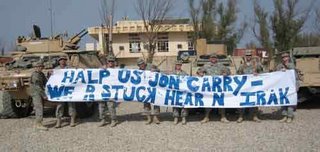
"You know, education, if you make the most of it, if you study hard and you do your homework, and you make an effort to be smart, uh, you, you can do well. If you don’t, you get stuck in Iraq."Today, within a matter hours, a picture raced its way around the globe, as some soldiers responded to Kerry's gaff, and his subsequent attempts to blame the negative reaction to his words on "despicable Republicans" and “Republican hacks, who have never worn the uniform of our country,” who misinterpreted a "joke." The photo (which for some reason I can't get to upload here) is a group of eight soldiers holding up a giant banner which reads, "HALP US JON CARRY-WE R STUCK HEAR N IRAK." In the photo the K is backward, but you get the picture, right?
Anyway, describing the image is a little anticlimactic, but the point they make is so important. I'm glad it's soldiers making it. Our soldiers are not in Iraq because they are stupid. They are there because they are brave, and self-sacrificing, and disciplined, and purpose-driven, and the list goes on. Many of them are also extremely well-educated. These men and women have the right to respect from all Americans, including the political leaders of this country. If you don't see what the big deal is, and why Internet and television pundits have jumped all over this, or why many people feel it's so important to defend the respect of our military, read N.Z. Bear's post. This isn't just a political issue, and an attempt to cash in on Kerry's blunder before the midterm elections. It's an attempt to defend our soldiers as they were not defended with Vietnam, when people like John Kerry led the way in condemning our military. There are many of us who won't sit by while that happens again, even if it is a "joke."
Okay, per reader request, I went to get link information on the photo, but decided to try to upload again, got it from another source, and got it to work. Here it is.
Update: Here's another examination of the Iraq/Vietnam connection to John Kerry's misstatement, at ShrinkWrapped.
(via Instapundit)
Tuesday, October 31, 2006
The Looting Of History
Remember all the indignation during the course of major fighting in the Iraq war, when the battle for Baghdad had been underway for a few days and we were told that all of the artifacts in the Iraq National Museum had been looted? Remember the reports that were broadcast and published for weeks, that all 170,000 artifacts the museum possessed, almost the entire history of the cradle of civilization, were hauled away or destroyed by wild mobs? Remember how the U.S. military was blamed for the incredible loss to human history, because supposedly soldiers stood by and let it happen? Well, I stumbled upon something today that puts the lie to those very public and prolonged accusations.
It's an old post, from July of 2005, by Frank Warner, who gives a very complete history, revealing that most of what was taken from the museum was in an inside job, not the result of militarily-tolerated looting, and could have fit into a single large backpack!! Many of the fifteen thousand items taken were beads, amulets, and the like. Warner writes that a huge percentage of the museum's artifacts remained undisturbed. "Ninety-seven percent of the museum’s items – 485,500 pieces – were preserved, 95 percent undamaged. " Yet U.S. soldiers are still blamed for the ruination of history.
Have you ever seen reports correcting the record? Have you ever heard the American military exonerated by the media, or archaeologists? (One archaeologist Warner quotes, Donny George, director of the Iraq National Museum, as good as admits his intention to milk the U.S. for money because of the terrible "loss." He's definitely not going to admit that the loss wasn't nearly as terrible as first proclaimed.) Apparently, some media sources have admitted their errors, but in the hushed and shy tones the media are wont to use when revealing their own fallibility. I certainly never heard any of the corrections. I'd be interested to know if any of you have. I'm betting the ranks of those who have are pretty thin. History was looted all right, just not the history we thought.
Friday, October 27, 2006
For The Record
Strategy Page has an interesting piece about efforts by the U.S. Department of Defense to counter misleading information coming out of the media. I say, "It's about time!!" I suspect a lot of us would agree that this is necessary, and have, in fact, been quite frustrated at the drumbeat of "failure, inadequacy, and stubborn refusal to face the truth" that has been the consistent slant of much of the media for the last five years. Some of us, myself definitely included, have also been frustrated at the lack of response and countermeasures from both the DOD and the Bush administration, especially because many of us (those of us who have been paying closer attention than just reading the headlines of The New York Times) have known all along that there were plenty of potential responses available to counter some of the unjust accusations constantly being hurled at the war effort. Turning the other cheek is truly a good thing in personal matters. Not taking offense when personally attacked can often diffuse a difficult situation, but it is inappropriate to amplify that maxim to apply to this war. We are not going to mollify the enemy because we don't correct our critics. This is a war in which accurate information is crucial to fighting a very media savvy enemy; we can't afford to let misinformation slide when it concerns the prosecution of the war.
So, the Department of Defense is finally getting more aggressive about joining the information fray. The DOD now has a website just for the purpose of correcting media errors regarding military matters, responding to slanted and inaccurate editorials (such as recent New York Times opinion pieces with which the DOD takes issue), and publishing letters to the editor, which various media outlets refuse to publish, responding to those editorials and content inaccuracies. The site is called For The Record, and it takes on a whole host of issues, with sections such as Iraq Security Update, Nature of the Enemy, Correcting the Record, Heroes, Pentagon Weekly Wrap-up, and Special Reports. Each of these pages is pretty much what it sounds like. For example, the "Heroes" page is a look at some of the people who have been fighting the War on Terrorism, and what they've accomplished (something sadly lacking in general media coverage.) "Correcting the Record" responds to specific media and editorial accusations--quite thoroughly, I might add. There are also stories on the website's front page, dealing with developing media issues.
One interesting thing I noted while perusing the DOD's site is the number of times the Department has tried (to no avail) to correct the record through regular media channels, letters to the editor and offers to provide further information. For some reason, the media outlets in question have been reluctant to publish these letters, and been unreceptive to offers of what some might see as the inside scoop. Since such letters have gone unpublished, and such offers have been refused, For the Record is an opportunity for the Pentagon to get its side of the story out to those people who, unlike much of the media, might be interested in hearing the other side.
There's a lot there to read. I'm probably going to be checking For The Record fairly regularly, just to hear the other side of the story. I'm not saying that the DOD won't have its own slant and perspective. Of course it will try to paint its performance in the best light it can. What I am saying is the Pentagon is finally dealing with misleading statements like the one in a September 7th New York Times editorial saying, “President Bush finally has some real terrorists in Guantánamo Bay.” Right, like all the other detainees there have just been picked up for being ugly, or something. So much of the time remarks like this one have been allowed to slip with impunity into the American psyche, seemingly going unchallenged and unanswered. That is finally changing.
Update: I don't mean to imply that the Defense Department's site is brand new. As far as I can tell it's been up for at least a year, but this is the first I've heard of it. Since I tend to be slightly more Internet-engaged than most of the people I know, I'm guessing a few of you haven't heard of it either. Maybe the DOD is getting the word out a little more about its resources. If that's the case, again I say, "It's about time!!"
Hat tip: Instapundit
